- Domain Name
- Domain Parts
- First level domain extensions
First level domain: The TLD at the top of the domain name hierarchy

TLD-list
Editor team
Truly a synonym for TLD, domain extension or web ending, the last part of a domain name after the final dot, like .com or .uk. "First level" and "top level" describe exactly the same position: the top of the hierarchy. Along with the other parts of a domain: the second and third levels, it forms a domain name. In some countries there are structured sub-levels like .co.uk that push registerable names down to the third level. This guide walks through all of them, explains which ones you can actually register, and shows where unofficial sub-level extensions like .uk.com fit in.
How a top-level domain fits into the domain name system (DNS)
The domain name system (DNS) is the name system of the internet. Its job is to turn a human-readable domain name into the numbers a network can route, so that when you type a web-style name your browser finds the right server. At the internet top-level, the top-level domain is the first stop on that journey. At the very top sits the DNS root, also called the DNS root zone. This root is coordinated by the Internet Corporation for Assigned Names and Numbers (ICANN). ICANN delegates technical operation of the root to the Internet Assigned Numbers Authority (IANA), which handles assigned names and numbers and publishes the authoritative list of every extension. ICANN, in turn, accredits the companies you buy names from. Resolving an internet domain works top-down. A root server answers first, then points to the correct TLD server for the extension. That server points to the operator's name servers, which finally return the IP address for the exact name you asked for. This is how the DNS maps domain names into IP addresses in a fraction of a second, and every TLD ultimately resolves to an IP, the numeric address of a machine on the network. The protocol rules behind it are maintained by the Internet Engineering Task Force (IETF), which also reserves the odd special-use domain name (such as .localhost) that never appears in the public root.
How domain levels work: everything below the TLD is a sub-domain
In theory, every domain below the top-level domain is a sub-domain of the one directly above it, even though in practice we rarely call them that. The name you register, the second level, is a sub-domain of the TLD. A third-level domain sits beneath it. The number of domain levels is technically unlimited, but for a memorable domain it usually stops at three. Reading a domain from right to left reveals the hierarchy. Take blog.tld-list.com:
The subdomain (blog) requires no separate registration. The owner configures it in DNS for free. The registered name (tld-list) is what you pay for at the second level, together with its extension. For more on how each component fits together, see parts of a domain name and the guide to setting up subdomains.

What about fourth level domains?
When a country uses a structured second level like .co in example.co.uk, the registered name (example) is pushed down to a third level. A subdomain of that, say www.example.co.uk, is a fourth-level domain. This is why understanding the level system matters before you register.
Types of top-level domains: gTLDs, ccTLDs, sponsored, and infrastructure
There are four main categories, and knowing these groups helps you pick from the available TLDs. The four main types of TLDs break down like this:
- Generic top-level domains (gTLDs). The generic TLDs include .com, .net, .org, and .io, plus the new generic top-level domains introduced since 2013. These new gTLDs and the other new TLDs are open to anyone worldwide, and the .com domain remains the main TLD most projects reach for first.
- Country code top-level domain options (ccTLDs). These country code domains, such as .us, .de, and .uk, are each delegated to a country's own operator. Some of these country-code top-level domains require local presence, and internationalized country code top-level domains (IDN ccTLDs) support non-Latin scripts.
- Sponsored top-level domains (sTLDs). The sponsored TLDs include .gov, .edu, and .mil. Each sponsored TLD (an sTLD) is restricted to specific institutions or government bodies.
- Infrastructure top-level. The infrastructure TLD is the .arpa domain, standing for the Address and Routing Parameter Area, a name that traces back to the Advanced Research Projects Agency behind the early internet. Alongside it, the int TLD (.int) serves treaty organizations, and .test is one of the reserved test top-level domains used for documentation and trials, not for a new domain you would register.
For a complete breakdown, see TLD categories, including types of domain names. The second level behaves differently depending on which extension sits above it. Under a generic TLD, there is no official, separately registerable second level. You register your chosen name directly at the second level, and that is the whole product. Under many ccTLDs, the operator reserves structured second levels that act as categories, and you register a name at the third level beneath them. This only applies fotor ccTLDs, not gTLDs. This is th e gap, unofficial pseudo-SLD business described below is built to fill. You can also filter by domain level directly on TLD-list.

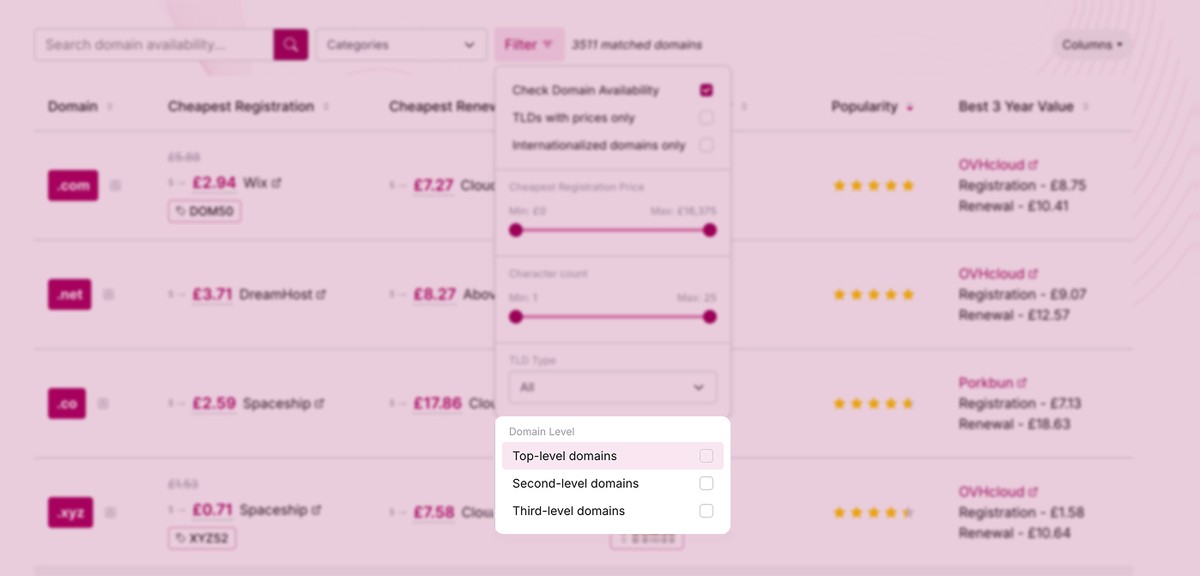
Filtering domains by level
The main comparison table at TLD List includes a Domain Level filter (top-level, second-level, third-level) defined as "the number of dot-separated labels in the full domain extension."
Official country sub-level domains (ccSLDs)
Some countries do not sell names directly under the country code. Instead, the operator reserves structured second levels that act as categories, and registrants buy at the third level beneath them. This mirrors what .com, .net, and .org originally meant (commercial, network, non-profit), pushed one level deeper inside a country structure. Concrete, verified examples:
- United Kingdom (.uk). co.uk for commercial use, ac.uk for academic institutions, sch.uk for schools. A name registered as example.co.uk is technically a third-level registration beneath co.uk.
- Brazil (.br). Over 140 predefined second levels, including com.br, vet.br, and wiki.br. (Source: Wikipedia, "Country code second-level domain.")
- Others. com.au (Australia), co.jp (Japan), co.za (South Africa). The historical reason: early operators used the second level to sort registrants by purpose and make policy enforcement easier. This is largely a country-code phenomenon. The original gTLDs (.com, .net, .org) never adopted official second-level categories. Because these second levels are run by the country's own operator, domains under them carry a genuine local-presence signal that unofficial alternatives cannot replicate. TLD-list surfaces this directly. The Sub-level Domains section on any extension page lists publicly registerable sub-levels with the cheapest available price.
Unofficial sub-level extensions (pseudo-SLDs): a private sub-domain registry
Because gTLDs have no official sub-levels, a private company built its own. Team Internet (formerly CentralNic) owns premium short names, mostly two-letter ISO 3166 country codes such as us, uk, and eu, as second levels under real TLDs (.com, .net, .org, plus the country-code .de), then sells third-level names beneath them. So in example.uk.com, .com is the TLD, uk is Team Internet's own SLD, and example is the third-level name you buy from a private company, not from the registry.
Choosing the right domain extension
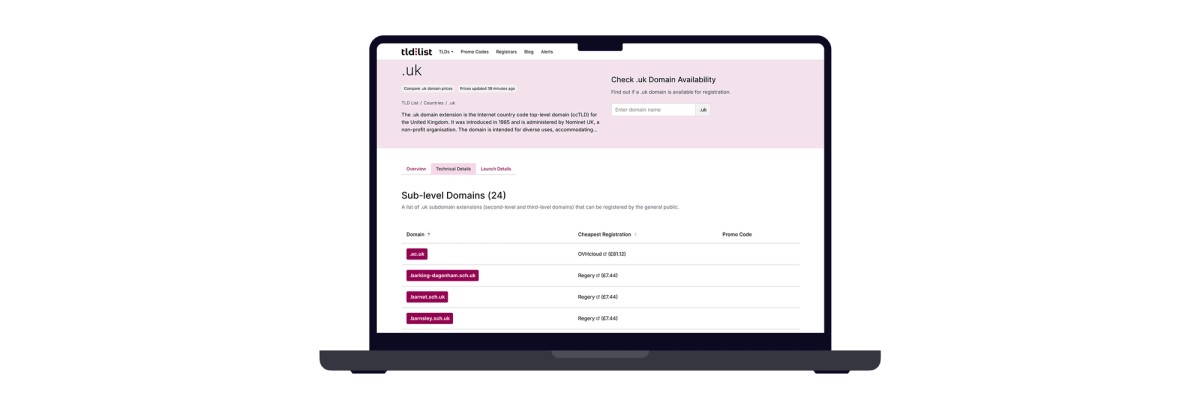
Check sub-levels on any ccTLD page: Each extension page includes a Sub-level Domains section listing publicly registerable sub-levels with the cheapest available price. For example the .de TLD page shows .com.de and .co.de with prices from multiple registrars.
Choosing a domain name comes down to a few practical checks, and the choice of TLD matters as much as the name itself:
- For most projects, a first-level .com remains the safest default. It works as a global domain for worldwide reach, and anyone can register a domain under it without restrictions.
- For a single-country focus, prefer the official first-level ccTLD, or its official second-level extension, which in some countries like the UK, Argentina, or Brazil are as popular as the first-level country code extension.
- Always compare both registration and renewal prices before you buy. The cheapest first-year price rarely reflects the long-term cost of domain management. Domain registration itself happens through an ICANN-accredited registrar. Whether you register a domain name on a fresh gTLD or register a new domain under a country code, comparing prices first keeps ongoing renewals under control. Compare every extension by domain level, registration price, and renewal price across 100+ registrars on TLD-list.
Frequently Asked Questions
In principle, yes. Each level below the top-level domain is technically a sub-domain of the level above it, even though we rarely use that language in everyday conversation. The name you register (second level) is a sub-domain of the TLD, and a third level like blog in blog.example.com is a sub-domain of that.
Not officially. Generic TLDs such as .com, .net, and .io do not offer structured, separately registerable second levels. Only some country-code TLDs do, for example co.uk or com.br. The .xx.com style extensions are the exception, and they are sold by a private company, not the .com registry.
No. .uk is the first level domain (the ccTLD). .co is an official country-code second level, so example.co.uk is a third-level registration beneath co.uk. The UK also uses ac.uk for academia and sch.uk for schools.
No. Extensions like .uk.com, .us.com, and .de.com are not official TLDs or official second levels. They are third-level names sold by a private company (Team Internet, formerly CentralNic) that owns premium short SLDs such as uk and us under real TLDs, and resells names beneath them as a private sub-domain registry. They can help when a .com is taken or a country requires local presence, but they do not carry the official local SEO signal of a real ccTLD, and you share the parent domain with every other owner under it.
Under a generic TLD, you register the second-level name (the name you choose) together with its extension. Under a country domain with structured second levels, the name sits at the third level, for example example.co.uk. Subdomains you add yourself (such as blog or www) are free and configured in your own DNS settings.
About the Author:

TLD-list
Editor team
Small crew of builders who believe a great idea should not be held back by a bad domain deal. We know this space inside out, from obscure new extensions to the registrar tricks that quietly inflate your renewal. We put that knowledge to work so you can spend less time worrying about domains and more time building the thing that matters.
Related Posts
How much does a domain name cost?
A standard domain name costs $10–$20/year, but the real number depends on your extension, registrar, and renewal price. This guide breaks down every factor, including premium domains, free options, and how to compare total costs accurately.
Read Full ArticleThe different types of domain names
A complete guide to the different types of domain: how domain names are structured (TLD, SLD, subdomain), every extension from .com and country-code TLDs to new gTLDs, and how to choose the right domain for your brand, budget and search visibility.
Read Full ArticleParts of a Domain Name
Learn the different parts of a domain name, including subdomains, second-level domains (SLDs), and top-level domains (TLDs). Understand how each component works, how they fit into a URL, and how to choose the right domain structure for branding, DNS, and SEO.
Read Full ArticleWhat is a fully qualified domain name?
Learn how FQDNs work, their structure, common uses, and how to find yours.
Read Full Article