- Domain Name
- Parts
The different parts of a domain (and what each one does)
Technically, a domain name has three main parts: a subdomain, a second-level domain (SLD), and a top-level domain (TLD)

TLD-list
Editor team
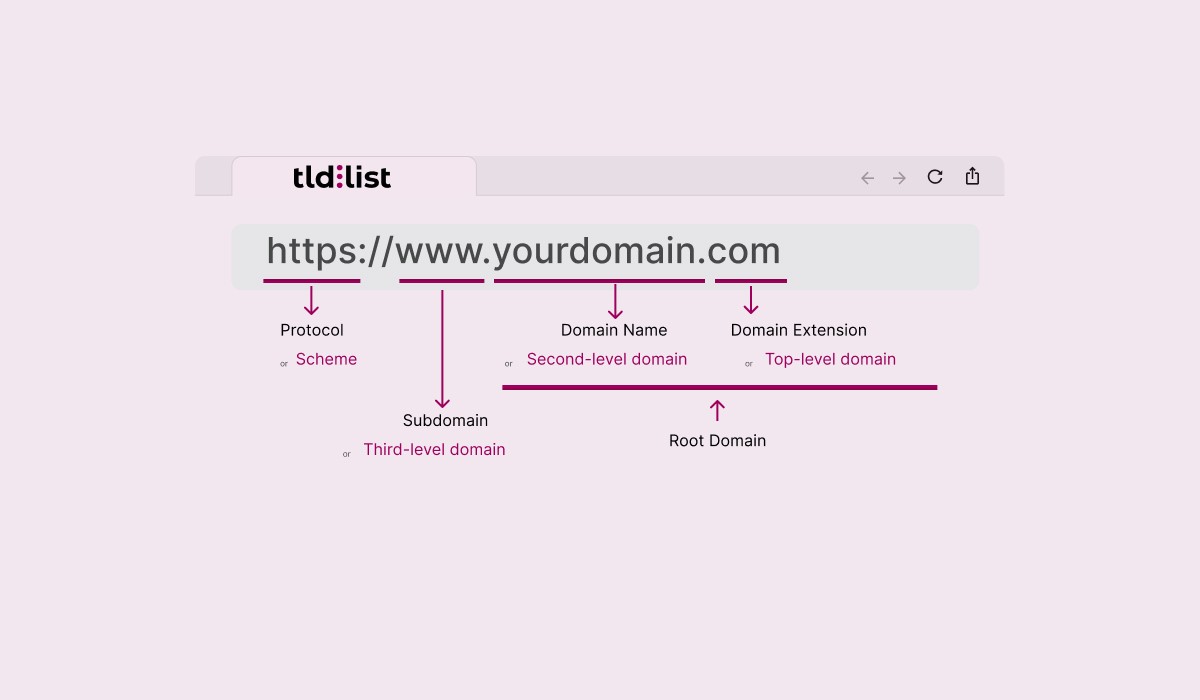
Each component serves a distinct role in identifying a website on the internet. Understanding the different parts of a domain name helps you make better decisions when registering a domain, configuring DNS, or structuring a site’s URL architecture. This guide covers each component, explains how they work together, and walks through the TLD types that matter most when choosing an ideal domain name.
A domain name is made up of labels separated by dots. Reading left to right, each label moves from the most specific to the most general:
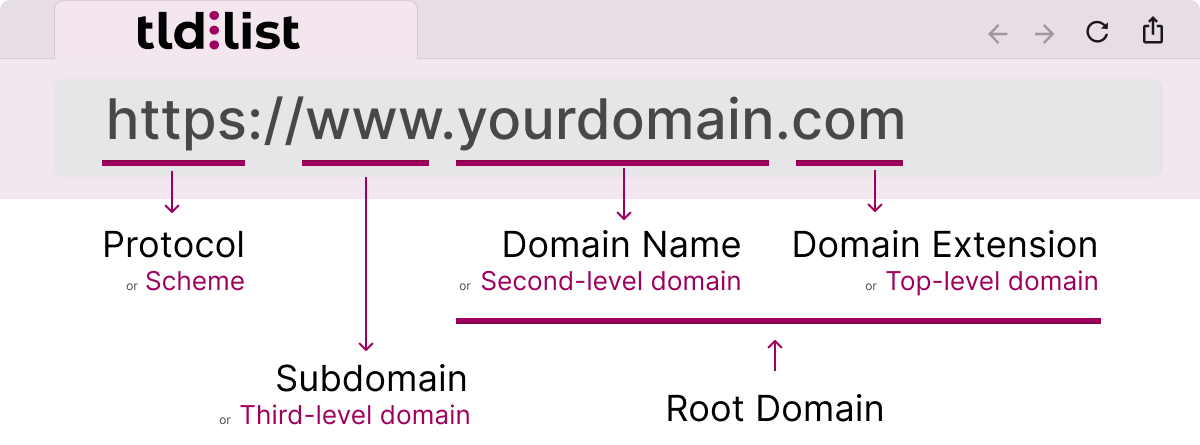
The table below summarizes the key parts of a domain name, with examples and function for each component.
| Component |
Example |
Function |
|---|---|---|
| Protocol | https:// |
Not technically part of the domain. Defines how data is transmitted between the browser and server. |
| Subdomain | blog (in blog.example.com) |
Organizes sections of a website; www is the most common subdomain. Controlled by the domain owner. |
| Second-Level Domain (SLD) | example (in example.com) |
The core, brandable part of the domain; chosen and registered by the registrant. |
| Top-Level Domain (TLD) | .com, .org, .io |
The extension after the SLD; managed by IANA/ICANN and delegated to registries. |
| Root Domain | example.com |
SLD + TLD combined; the main identifier of a website without any subdomain. |
The root domain is the combination of the SLD and TLD; example.com, not blog.example.com. When people refer to a domain name in everyday conversation, they typically mean the root domain.
Top-Level Domain (TLD)

Also known as a first level domain, the domain extension, domain suffix or ending, a top-level domain (TLD) is the last segment of a domain name; the part after the final dot, such as .com, .org, or .io. ICANN (Internet Corporation for Assigned Names and Numbers) oversees the domain name space and authorizes new TLDs. The IANA (Internet Assigned Numbers Authority), operated by ICANN, maintains the Root Zone Database listing every valid TLD and delegates the administration of each TLD to a registry. For example, Verisign manages .com, and Public Interest Registry manages .org.
These are the 4 main categories of TLDs. Explore the full list of domain extensions to compare available options:
| TLD Type |
Examples |
Who Uses It |
|---|---|---|
| Generic TLD (gTLD) |
.com, .net, .org, .info |
Any registrant worldwide; .com is the most widely used extension. |
| Country Code TLD (ccTLD) |
.us, .uk, .de, .fr |
Businesses or individuals targeting users in a specific country. |
| New gTLD |
.io, .ai, .tech, .store |
Niche audiences and specific industries; growing in popularity since 2013. |
| Sponsored TLD (sTLD) |
.gov, .edu, .mil |
Restricted to specific organizations, government bodies, or institutions. |
Second-Level Domain (SLD)

The second level domain (SLD) is the part of a domain name that comes directly before the TLD, it’s the name you choose to represent your brand or website. In example.com, "example" is the SLD. The SLD is what you register with a domain registrar, and it must be unique within each TLD: there is only one example.com, though example.net and example.org can be registered separately.
 Tips to use a good SLD
- Keep it short —> aim for under 15 characters. Shorter domain names are easier to type, share, and remember.
- Make it memorable —> avoid hyphens, numbers, and unusual spellings that create confusion when spoken aloud.
- Align it with your brand —> the SLD is the part of your domain name most associated with your identity online.
- Check for trademark conflicts —> verify the name is not already trademarked in your industry before registering a domain.
Because the SLD must be unique per TLD, registering multiple SLDs across different extensions, for example, both yourname.com and yourname.net, is a common brand protection strategy.
Third-level domain or Subdomain

A sub domain is an optional prefix added before the second-level domain, separated by a dot, for example, shop.example.com or blog.example.com. Subdomains are controlled entirely by the domain owner, do not require separate domain registration, and are configured through DNS settings (specifically, by adding records at your DNS provider or web host).
Common subdomain use cases:
- www ➝ the default subdomain for a website’s main homepage. Functionally equivalent to the root domain when configured correctly.
- blog ➝ a separate section for editorial content, often treated by search engines as an independent entity.
- shop ➝ a dedicated storefront section distinct from the main site.
- mail or webmail ➝ routes email access through a browser interface.
- api ➝ separates API endpoints from the main website for technical integrations.
From an SEO perspective, Google generally treats subdomains as independent entities from the root domain. Whether to use a subdomain or a subfolder (e.g., example.com/blog vs. blog.example.com) is an architectural decision with SEO implications. Subdomains can dilute link equity unless they are closely integrated with the main site.
For a more detailed comparison, see our guide on top level domain vs subdomain to understand how they differ in structure, purpose, and use.
How Do Domain Name Parts Fit Into a Full URL?
A URL (Uniform Resource Locator) is the complete web address of a specific page or resource. A full URL includes the protocol, the domain, a path, and optionally a query string:

Protocol

The protocol (HTTPS) defines the transfer protocol used for the connection. The path and query parameters identify the specific page or resource within the site.
Domain name

The domain name (subdomain + SLD + TLD) is the address that DNS resolves to an IP address on a server. When all levels are specified, including the DNS root, it’s called a fully qualified domain name (FQDN).
This article covers the domain portion; for a deeper look at the full URL structure, read the web.dev guide to URL components.
How to Choose the ideal Domain Name Parts
Choosing the right components for your domain name affects brand perception, memorability, andm in some cases, geographic relevance for search. Here are the key decisions:
TLD selection
- .com ➝ the most widely recognized domain extension worldwide. Best choice for maximum credibility and brand recognition.
- ccTLD (.uk, .de, .fr) ➝ use when your business primarily targets users in a single country. Sends a geographic relevance signal for local search.
- New gTLD (.io, .ai, .tech) ➝ suitable for niche industries or when the ideal domain name is unavailable on .com. Growing in recognition among tech and startup audiences.
SLD selection
Keep the SLD short (under 15 characters), easy to spell, and clearly connected to your brand or business name. Avoid hyphens and numbers. The SLD is the most important naming decision you will make, it stays with your brand for the life of the domain.
Subdomain decisions
Use www as the default subdomain for your main site. Create additional subdomains only for distinct sections with a clear purpose for users, such as a dedicated store, API, or support portal. Each new subdomain requires DNS configuration and, if you care about SEO, its own content and link-building strategy.
Compare TLD availability and registration prices across all extensions at TLD-List.com before making your final selection.
Key parts of an internet domain name FAQs
A domain name is the human-readable address of a website (e.g., example.com), made up of an SLD and a TLD. A URL (Uniform Resource Locator) is the full web address that includes the protocol (https://), the domain name, and a specific path or query string pointing to a page or resource. The domain is a component of the URL, not the same thing.
Yes. A domain name can have multiple levels. For example, mail.support.example.co.uk has a subdomain (mail.support), an SLD (example), and a two-part TLD (.co.uk). These multi-part TLDs are called second-level ccTLDs or country-code TLDs with an additional level. The IANA maintains the Root Zone Database listing all valid TLD combinations.
The TLD itself has minimal direct impact on global SEO. Google treats most TLDs equally, including new gTLDs like .io or .ai. ccTLDs can give a geo-relevance signal for country-specific searches. The most important SEO factors remain content quality, backlinks, and site structure — not the domain extension.
A ccTLD is a two-letter domain extension assigned to a specific country by the IANA — for example, .uk for the United Kingdom, .de for Germany, or .fr for France. Use a ccTLD when your business primarily targets users in a single country and you want to signal geographic relevance in local search results. For global audiences, a gTLD like .com is typically the better choice.
ICANN (Internet Corporation for Assigned Names and Numbers) oversees the domain name system and authorizes new TLDs. The IANA, operated by ICANN, maintains the official Root Zone Database listing every valid TLD. Registries like Verisign (.com) or Public Interest Registry (.org) are delegated to manage individual TLDs under ICANN authorization.
A third-level domain is another word for subdomain which lives in front of the second-level domain, separated by a dot. In blog.example.com, "blog" is the third-level domain. In some ccTLDs like .co.uk, the country code structure creates what is sometimes called a second-level ccTLD, making the registered name (e.g., example.co.uk) effectively a third-level domain.
About the Author:
TLD-list
Editor team
Small crew of builders who believe a great idea should not be held back by a bad domain deal. We know this space inside out, from obscure new extensions to the registrar tricks that quietly inflate your renewal. We put that knowledge to work so you can spend less time worrying about domains and more time building the thing that matters.
Related Posts
How much does a domain name cost?
A standard domain name costs $10–$20/year, but the real number depends on your extension, registrar, and renewal price. This guide breaks down every factor, including premium domains, free options, and how to compare total costs accurately.
Read Full ArticleThe different types of domain names
A complete guide to the different types of domain: how domain names are structured (TLD, SLD, subdomain), every extension from .com and country-code TLDs to new gTLDs, and how to choose the right domain for your brand, budget and search visibility.
Read Full ArticleWhat is a fully qualified domain name?
Learn how FQDNs work, their structure, common uses, and how to find yours.
Read Full ArticleHow to register a domain name
Learn how to register a domain name step by step, from choosing the right name and extension to comparing registrar prices, protecting your details, configuring DNS, and avoiding costly renewal and expiration mistakes.
Read Full Article