- Domain Name
- Types
The different types of domain names
Every domain name is made of two parts that matter most: the second-level domain (SLD) you register and the top-level domain (TLD) that follows the dot. Together this SLD + TLD pair forms your main domain, like tld-list.com, and it is the address the domain name system (DNS) uses to route visitors to your site.

TLD-list
Editor team
Registering a domain means securing that exact combination. This guide covers the two choices behind it: the Types of Domain Extensions (TLDs) available to you, which are also called domain endings or domain suffixes, and the wide range of Domain Names (SLDs) you can build on.
Domains work with three levels
A domain name is built from right to left, with each part separated by a dot. Let’s take the following example:
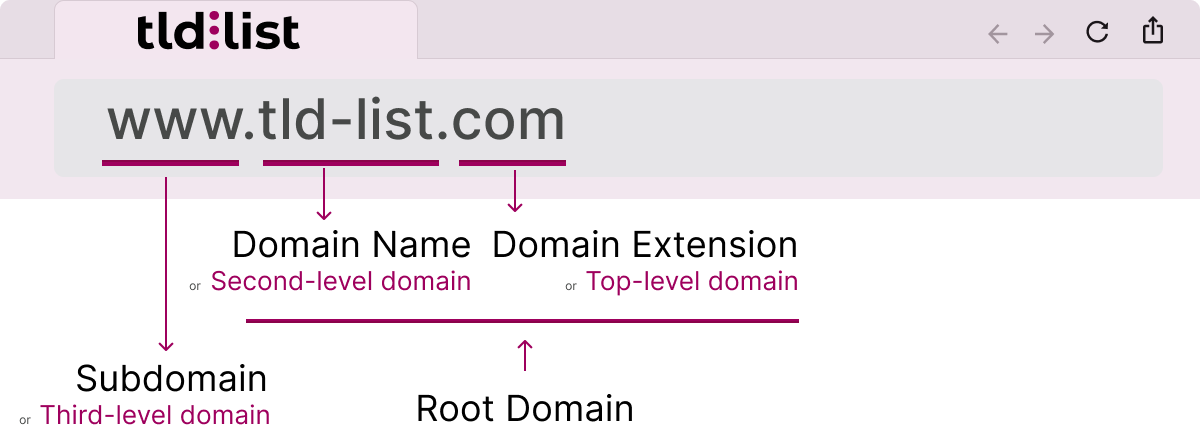
.com is the top-level domain (TLD), the extension, the rightmost label in the address
tld-list is the second-level domain (SLD), the name chosen at registration. This is what you are actually registering
www is the subdomain, a prefix configured by the domain owner in the domain name system (DNS) In everyday use, "domain name" or "domain" refers to the SLD + TLD combination, tld-list.com in this case, also known as the main domain. You can read more about how each domain part works at /blog/internet-domain-parts. Subdomains are not registered separately. They are configured in DNS by whoever controls the root domain. Registering a domain gives you control of the SLD + TLD pair for the registration period. Once registered, you can create as many subdomains as you need at no extra cost. Real-world domain name examples (/blog/domain-examples) show how the hierarchy works in practice.
Types of Domain Extensions or top-level domains (TLDs)
We can generally divide top-level domains into five categories. The category determines how a TLD is governed, who can register under it, and what renewal pricing looks like. For a broader overview of extensions by type, see the domain suffix guide, browse domain extensions by category, or see a complete list by letter here.
Generic top-level domains (gTLDs)
Generic top-level domains are open extensions available to anyone, with no geographic or sector restriction. The original generic top-level domains include .com, .net, .org and .info. Of these, .com is the most recognized globally. Once these domains are registered, they renew on an annual basis. Compare prices for the original generic extensions across registrars on TLD-list.
- Examples: .com, .net, .org
- Open to anyone? Yes
- Typical renewal/year: ~$10.00–$25.00
Country-code top-level domains (ccTLDs)
Country-code top-level domains (ccTLDs) are two-letter extensions assigned to specific countries or territories: .us for the United States, .de for Germany, .fr for France, .jp for Japan. Some ccTLDs are open to anyone. Others require local presence or proof of residency. These country-specific domains can send a local ranking signal to search engines, which makes country code top-level domains a common choice for a country-specific business. Browse country-code TLDs to compare pricing and registration requirements by country.
- Examples: .de, .fr, .us
- Open to anyone? Varies by country
- Typical renewal/year: ~$5.00–$85.00
Country-code registry-reserved ccSLDs
In addition to ccTLD, some countries also sell SLD domain names directly under the ccTLD. Meaning, the registry reserves a set of official second-level domains that function as categories, and you register at the third level beneath them. The UK is the most prominent example. The .uk registry operates co.uk for commercial businesses, org.uk for non-profits, and me.uk for individuals. Registering a UK domain name typically means choosing something like mybusiness.co.uk. Australia follows a similar model: .com.au for commercial use, .org.au for non-profits, .edu.au for educational institutions. These official SLDs are set and maintained by the country registry. They are not the same as a subdomain you configure yourself. They are part of the formal domain hierarchy that the registry controls.
- Examples: .co.uk, .com.ar, .com.br
- Open to anyone? Varies by country
- Typical renewal/year: ~$5.00–$25.00
New generic TLDs (new gTLDs)
ICANN's new generic top-level domain program, launched in 2013, introduced new types of domains by expanding the system with over 1,200 new extensions. Many are industry-specific: .tech for tech and SaaS products, .app for mobile and web applications, .shop for e-commerce. These new extensions often launch with promotional pricing under $1.00 in year one, but renewal costs can run $40.00–$100.00 or more per year. Always check the renewal price before registering a new domain.
- Examples: .app, .shop, .xyz, .tech
- Open to anyone? Yes
- Typical renewal/year: $15.00–$100.00+
Reserved/Sponsored TLDs (sTLDs)
Sponsored top-level domains have eligibility requirements enforced by a sponsoring organization. The .edu extension is restricted to US-accredited educational institutions. The .gov extension is limited to US government entities. The .mil extension is reserved for the US military. These sponsored top-level domains (sTLDs) cannot be registered by the general public.
- Examples: .edu, .gov
- Open to anyone? No
- Typical renewal/year -
Infrastructure TLD
.arpa is reserved for DNS infrastructure functions such as reverse DNS lookups. It is not available for public registration and exists solely to support how the domain name system routes traffic.
Types of Domain Names or Second-level
The second-level domain is the part you choose when you register domain names, the "tld-list" in tld-list.com. It is what you control for the duration of the domain registration. SLDs generally take one of four practical forms.
Brand domains
A brand domain uses a unique company or product name as the SLD: stripe.com, airbnb.com, notion.so. This is the strongest approach for long-term recognition and memorability. A strong domain carries no inherent keyword signal, but it builds a clean, distinct identity over time.
Keyword + brand hybrid domains
A hybrid combines a descriptive keyword with a brand or function name. tld-list.com is one example: "TLD" signals the subject area and "list" signals the format. This approach balances descriptive relevance with brand identity.
Exact-match domains
An exact-match domain uses a target keyword directly as the SLD, for example domains.com for a domain registrar. These can generate direct type-in traffic, but they often feel generic and can be harder to differentiate in competitive spaces.
Premium domains
A premium domain is a short or high-value SLD that is either reserved by the registry to sell at higher prices than standard domains or registered early by a private entity and is now available only on the secondary market at a higher price. Examples include 2 or 3 letter SLDs, or domains like cars.com and insurance.com, which have sold for millions of dollars. Premium domain pricing is a one-time purchase from the current owner and is separate from regular registration and renewal fees.
Types of subdomains or third-level domains
A subdomain is a prefix added in front of your registered domain to create a distinct section of a site, like blog.example.com or shop.example.com. Because a subdomain sits at the third level, you can add as many as you want once the domain is registered, at no extra cost, and point each one at different content or services. Subdomains are handy for separating a distinct area, such as a store, a help center, or a developer environment, from the rest of the site. They are not always the right choice. Search engines often treat a subdomain as a partly separate site, so for content meant to strengthen your primary site, a subfolder like /blog usually consolidates authority better. For a full look at the pros and cons, and when a subfolder wins instead, see this guide on subdomains. The table below covers the subdomains you will run into most often.
| Subdomain | Common use |
|---|---|
| www | The conventional prefix for the main public website, e.g. www.example.com |
| blog | Hosts a company blog or news section kept separate from the main site |
| shop / store | Runs an e-commerce storefront apart from the primary marketing site |
| app | Serves a web application or the logged-in product dashboard for users |
| api | Exposes an API endpoint for developers, integrations, and services |
| mail / webmail | Provides access to email services or a browser-based webmail login |
| support / help | Hosts a help center, knowledge base, or customer support portal |
| docs | Publishes product documentation, guides, and developer reference pages |
| en / es / fr | Language subdomains that serve localized versions of the same site |
| dev / staging | Non-public environments for testing changes before they go live |
| m | A dedicated mobile version of a site on older setups, e.g. m.example.com |
| status | Shows real-time uptime and incident reports for a product or service |
| Custom | The entry-level free version of website builders like Wordpress, Squarespace or Wix often comes with a custom subdomain. As a part of pay plans, you can map your site to a custom domain. |

Email domains
Domains can also be used for email, and our guide to email domains explains how they work and how they relate to your website’s domain.
Choosing a domain for SEO: what actually matters
The SEO implications of domain type choices come up often. Here is a factual breakdown:
- Standard extensions vs. new extensions: Google treats most TLDs equally for ranking. A .io or .ai domain is not penalized, and there is no confirmed ranking boost for .com. Rankings depend on content quality, relevance, and backlinks, not the extension. The TLD is not a ranking factor by itself.
- ccTLDs and local search: Google treats ccTLDs as a geographic signal. A .de domain is more likely to rank in German search results because Google infers the site targets Germany. If you’re unfamiliar with the term, our guide to ccTLD meaning explains how country-code extensions work and when to use them. For businesses serving a global audience, a generic extension with geo-targeting configured in Google Search Console often works better than a ccTLD.
- Subdomains vs. subdirectories: Google has stated both can work for search. In practice, consolidating content under subdirectories (/blog rather than blog.domain.com) tends to simplify crawl consolidation and keeps internal link authority flowing to one root domain.
- Premium domains: a short, memorable domain name can generate direct type-in traffic and supports stronger brand recall. However, Google does not give any ranking advantage based on a domain's age, perceived value, or length alone. Rankings come from content and links, not the address.
How to choose the right domain type for your project
Four questions narrow down the decision and point you toward the right domain name.
Who is your audience and where are they? For a global audience, .com is the safe default. For a business targeting one specific country, a matching ccTLD is worth considering.
What does the extension signal? A tech product in the SaaS or AI space fits naturally with .io or .ai. A non-profit organization reads better on .org. An e-commerce store works on .com or .shop. These are not strict rules, but extension signals do shape first impressions, and a good domain name aligns the ending with what you actually do. For more creative options, explore our selection of cool domain extensions to find an ending that makes your brand stand out.
What is the long-term cost of a domain? Many new extensions use promotional pricing under $1.00 in year one. The renewal price, what you pay from year two onward, is what matters for budgeting. Compare renewal prices rather than introductory specials. The range of domains you can register keeps growing, so weigh each option on its total cost, not its first-year deal. If cost is the deciding factor, review free domain options and understand any limitations.
Is the .com available? If the .com for your chosen name is taken, a relevant new extension or a closely matched ccTLD is often cleaner than a hyphenated or altered .com. Choosing a domain name you can own outright matters more than forcing a .com fit. There is rarely a single perfect domain, so if you manage one brand across several markets, registering multiple domains to protect the name can make sense. One more consideration regardless of domain type: domain privacy protection, also called WHOIS privacy, is a service offered by most registrars that replaces your personal contact information in the public WHOIS database with a proxy address. It is worth enabling on any domain registration.
Frequently asked questions
Domain names can be categorized in many ways: by structural level (TLD, SLD, subdomain), by extension (generic top-level domains, country-code TLDs, new generic TLDs, sponsored TLDs), or by the type of second-level domain chosen.
In everyday use, "domain type" usually refers to the extension category, whether the domain ends in .com, .org, a country code like .de or .us, or a newer extension like .io or .ai.
.com is the most registered domain extension globally, with over 303 million registered domains. It is the default choice for most websites and is recognized by audiences worldwide regardless of industry or country.
Google treats most new extensions the same as .com for ranking purposes. .app and .shop rank based on content quality, backlinks, and relevance, not the extension itself. The main ranking consideration for extension choice is whether to use ccTLDs for local search signals, not standard extension vs. new extension.
A premium domain is a second-level domain that was registered early and is now available only on the secondary market at a higher price. Examples include single-word domains like insurance.com or hotels.com, which have sold for millions. Premium pricing is a one-time purchase from the current owner and is separate from annual renewal costs.
Domain privacy (also called WHOIS privacy) is a service that replaces your personal contact information in the public WHOIS database with a proxy address. It is available for most generic top-level domains and many ccTLDs through registrars that support it. It does not affect how the domain works, only who can see the registrant contact information.
About the Author:

TLD-list
Editor team
Small crew of builders who believe a great idea should not be held back by a bad domain deal. We know this space inside out, from obscure new extensions to the registrar tricks that quietly inflate your renewal. We put that knowledge to work so you can spend less time worrying about domains and more time building the thing that matters.
Related Posts
How much does a domain name cost?
A standard domain name costs $10–$20/year, but the real number depends on your extension, registrar, and renewal price. This guide breaks down every factor, including premium domains, free options, and how to compare total costs accurately.
Read Full ArticleParts of a Domain Name
Learn the different parts of a domain name, including subdomains, second-level domains (SLDs), and top-level domains (TLDs). Understand how each component works, how they fit into a URL, and how to choose the right domain structure for branding, DNS, and SEO.
Read Full ArticleWhat is a fully qualified domain name?
Learn how FQDNs work, their structure, common uses, and how to find yours.
Read Full ArticleHow to register a domain name
Learn how to register a domain name step by step, from choosing the right name and extension to comparing registrar prices, protecting your details, configuring DNS, and avoiding costly renewal and expiration mistakes.
Read Full Article