- Domain Extensions
- Domain Extension Types
- ccTLD Meaning
What is a ccTLD? country code top-level domains explained
ccTLD stands for country code top-level domain. It is a two-letter domain extension assigned to a specific country or territory by IANA based on ISO 3166-1 alpha-2 country codes.

TLD-list
Editor team
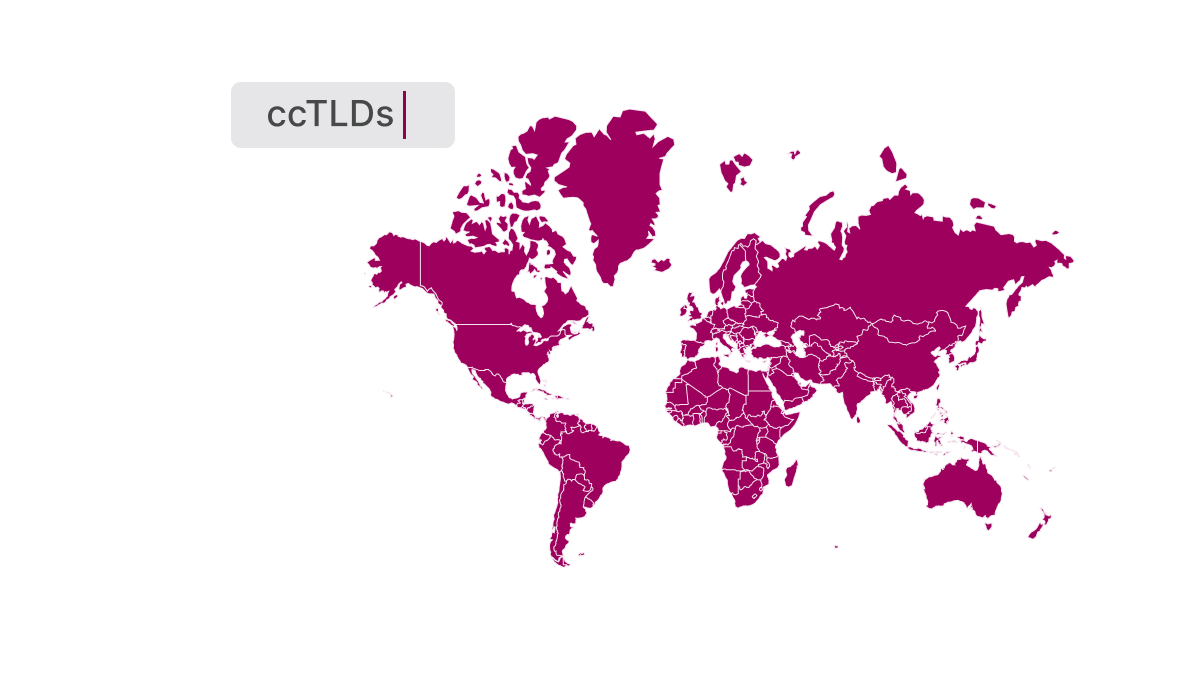
Around 300 active ccTLDs exist, spanning both sovereign nations and dependent territories. They send a geographic trust signal tied to a particular country or territory, which makes them a stronger fit when your target audience is based in a single market rather than globally.
What does ccTLD stand for and how is it assigned?
ccTLD stands for country code top-level domain. IANA, the Internet Assigned Numbers Authority, assigns two-letter codes based on the ISO 3166-1 alpha-2 standard, the same system used for country codes on passports and international mail. Using country classifications from that standard, IANA gives every country or dependent territory its own two-letter code, and that code becomes its ccTLD. These extensions are formally known as country code top-level domains. Country codes like .uk, .de, and .ca show the pattern clearly: .uk goes to the United Kingdom, .de to Germany, and .ca for Canada, the same two-letter logic that gives Japan its .jp.
Over 300 active ccTLDs exist across the world, though a handful account for the majority of registrations. IANA publishes and maintains the authoritative list, but day-to-day management is delegated to country-level registry authorities, not to ICANN, the Internet Corporation for Assigned Names and Numbers, directly, and each registry answers to its respective country rather than to a single global body. This means each ccTLD registry controls its own rules, and every standard ccTLD still follows the same two-letter format regardless of who manages it. Some ccTLDs are open-use, meaning anyone anywhere can register a domain regardless of location. Others are restricted, and these ccTLDs require proof of local presence, citizenship, or a registered business in the country. Registration policies, pricing, and restrictions vary widely from registry to registry; some restrict registration to a specific country or region, others don't, so checking the rules before you register a ccTLD is always the right first step.
Not every ccTLD is limited to the Latin alphabet used for .uk or .de. An IDN ccTLD, short for internationalized country code top-level domain, lets a country's extension appear in its own script, such as Cyrillic, Arabic, Chinese, or Devanagari, instead of standard ASCII characters. These IDN ccTLDs, also called internationalized ccTLDs, sit alongside the traditional two-letter version of each country's extension rather than replacing it.
Internationalized country code top-level domains work through a technical process called Punycode, which translates local-script characters into an ASCII-compatible string that the domain name system can still resolve. To a browser, an internationalized domain such as россия (Russia's Cyrillic ccTLD) functions the same as any other extension; it simply displays using the script native to that nation.
Countries with non-Latin writing systems, including Russia, China, Egypt, and India, have adopted these extensions based on the ISO 3166-1 country codes assigned to them, extending the same ISO 3166-1 alpha-2 country codes framework into local scripts. The goal is to help internet users who read and type in their own alphabet rather than a transliterated version, and to strengthen a company's internet presence with a domain name that's genuinely written the way residents write it themselves.
For a full rundown of the scripts, countries, and technical details behind these extensions, see TLD-list's guide to IDN ccTLDs.
Full list of country code top-level domain examples: common extensions and what they signal
Two-letter country codes cover every recognized country and territory. Choosing a ccTLD domain means opting into that country's specific rules and reputation. Some ccTLDs stay tightly tied to their home countries with strict registration rules; others have become globally popular precisely because their registries opened them up to anyone. Examples include .io, .ai, and .tv. The table below shows a selection of well-known ccTLDs, the country they are assigned to, and the key signal or restriction associated with each.
For a full breakdown of every active country domain extension, browse the complete domain list at:
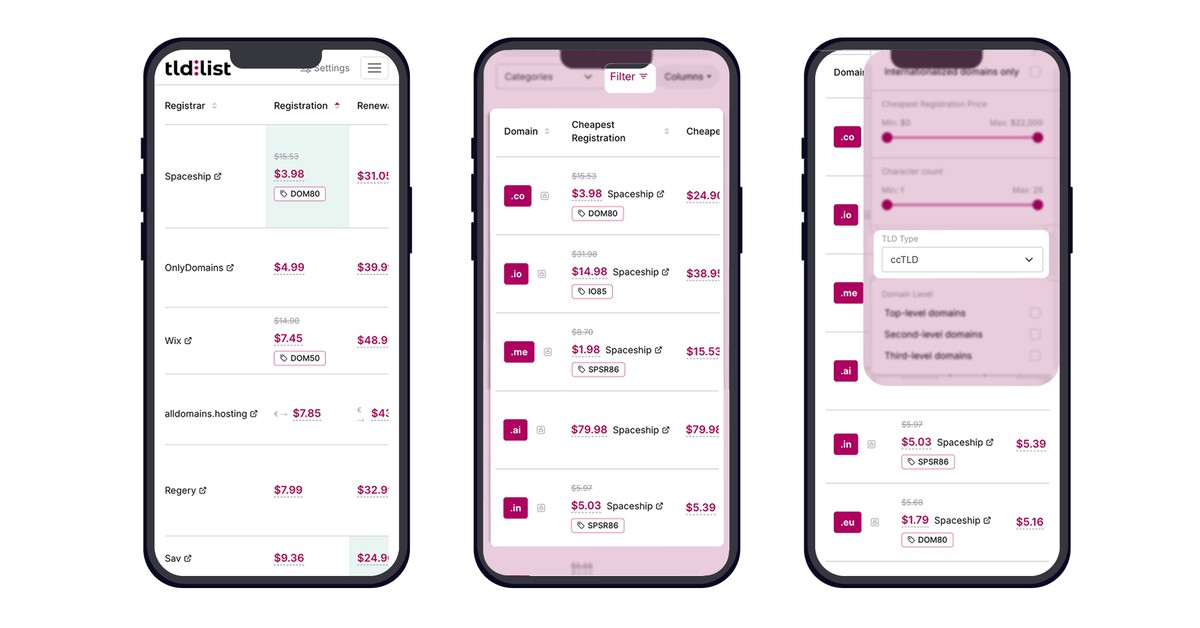
Popular ccTLDs and Facts About Them
| ccTLD | Country | Notes |
|---|---|---|
| .uk | United Kingdom | Standard geographic; restricted to UK residents and businesses |
| .de | Germany | Most registered ccTLD in Europe |
| .fr | France | Requires EU/EEA presence |
| .us | United States | Open use; often overlooked next to .com |
| .io | British Indian Ocean Territory | Open use; widely adopted by tech startups globally |
| .ai | Anguilla | Open use; surged with AI industry growth |
| .tv | Tuvalu | Open use; popular with video and streaming platforms |
| .co | Colombia | Open use; marketed as .com alternative for startups |
| .ca | Canada | Restricted to Canadian presence |
| .au | Australia | Restricted; requires Australian nexus |
The .fr extension, for instance, requires an EU/EEA presence, reflecting France's status within the European Union. The split between restricted and open-use ccTLDs matters for anyone considering a country domain extension. Restricted ccTLDs tend to carry stronger local trust signals because registrants have actually verified their connection to the country. A quick look at any ccTLD shows how much registration rules can vary between neighbors. Open-use ccTLDs can be registered by anyone but may carry different geographic (or no geographic) implications depending on how search engines treat them. Some, like .io and .co, are marketed well beyond their specific countries of origin.
Types of domains: the two kinds of TLDs
Top-level domains fall into two broad categories: country code TLDs (ccTLDs) and generic top-level domains (gTLDs). Understanding these two types of domains helps in choosing the right extension for a given project or audience. Different types of websites, from personal blogs to global e-commerce stores, often choose their extension based on audience reach rather than habit.
ccTLDs are two letters long and tied to a specific country or territory. They are managed by national registries, each with its own rules. gTLDs, such as .com, .net, .org, and the newer extensions like .app or .store, are generic domains open to registrants anywhere in the world and are managed by ICANN-accredited registrars. Unlike ccTLDs, gTLDs carry no built-in geographic signal. The table below compares them across the dimensions that matter most when making a registration decision.
| Dimension | ccTLD | gTLD |
|---|---|---|
| Scope | Country or territory-specific | Global, open to anyone |
| Registration requirements | Varies; many require local presence | Generally open with no restrictions |
| Price variability | High, set by individual national registries | Moderate, set by ICANN-accredited registrars |
| Primary use case | Single-country audience; local trust building | Global audience; brand recognition |
The choice between a ccTLD and a gTLD comes down to audience and intent. If a business is targeting users in a specific country and wants a clear local trust signal, a ccTLD often makes more sense. If the goal is a global audience across multiple countries, a gTLD like .com typically serves better. A business managing multiple domains across different country extensions often centralizes on a single gTLD instead, just to simplify upkeep and keep one domain as the canonical home for the business.
Do country code top level domains affect SEO?
Yes, ccTLDs send a strong geographic signal to search engines. Google is the dominant search engine for geotargeting purposes, and it uses the ccTLD as a geotargeting signal, meaning a site on .de is understood to be targeting users in Germany. This can improve visibility in that country's search results, but the trade-off is reduced potential for global rankings. A site built specifically for one country audience on its ccTLD is unlikely to compete as broadly in international results as an equivalent site on .com.
Two key facts shape how ccTLDs interact with SEO. First, Google Search Console allows site owners to manually set a geographic target for gTLD sites, but not for ccTLD sites. Any search engine that supports geotargeting infers the target automatically from the ccTLD itself, so no manual configuration is needed or available. Second, not all ccTLDs carry this geographic restriction in practice. Some open-use ccTLDs, particularly .io and .ai, are treated by Google as generic extensions, meaning no automatic geotargeting is applied and the domain is no longer strongly associated with any specific country. A site on .io is not assumed by Google to be targeting the British Indian Ocean Territory; it is treated more like a gTLD.
This distinction matters for startups and tech companies that use a ccTLD like .io or .ai for brand reasons without intending to target a specific country. They get the clean two-letter domain without the geographic ranking restriction, a big reason certain ccTLDs have become global favorites outside their home territory. For the full list of ccTLDs that Google treats as generic extensions (sometimes called gccTLDs)
When to use a ccTLD: the use of ccTLDs explained
The advantages of ccTLDs go beyond geographic SEO signals, and the use of ccTLDs for local trust-building keeps growing every year. Use a ccTLD when your target audience is concentrated in one country, when local trust is critical to conversion, or when the local registry signal carries real weight in that market. Whether you're about to build a website for a single national audience or a sprawling global one changes which extension makes sense. A German business operating exclusively in Germany benefits from .de, not just for SEO, but because local customers recognize and trust the extension. The same logic applies to .ca in Canada or .fr in France, and it extends to choosing a relevant domain name that matches how residents already search.
Use ccTLDs when local trust matters most
Before committing to a specific ccTLD, weigh the registration requirements against your actual audience. Restricted ccTLDs work best when a business genuinely operates within a certain country or region and has nothing to gain from a global audience. A country-specific domain like .de or .fr can help a local business feel native to its market in a way a generic .com rarely does, and a well-chosen ccTLD may help reinforce that sense of belonging every time a customer sees the URL.
Stick with .com or other gTLDs when you need global reach
- Global audience: if you are targeting users across multiple countries, a gTLD avoids the geographic restriction that comes with a ccTLD
- Brand recognition matters more: for many sectors, .com still functions as the default global domain choice, carrying more built-in recognition than a country-specific alternative
- Registration restrictions apply: if you do not meet the local presence or residency requirements for a restricted ccTLD, a gTLD is the practical alternative
There is no single right answer. The decision depends on the business, the audience, and the growth plan. A startup targeting only the UK market might find .co.uk, which relies on a second-level domain structure recognized across the UK, or .uk to be a better long-term asset than a .com that signals no particular geographic intent. A SaaS company targeting customers across North America, Europe, and Asia would likely be better served by .com.
Before registering any ccTLD or committing to a new domain, use TLD-list to find available domain options and compare domain price differences across registrars. Registry pricing for ccTLDs varies significantly, sometimes by a factor of ten or more between the cheapest and most expensive registrar for the same extension, and ccTLDs also differ in renewal and transfer rules.
ccTLD FAQ
ccTLD stands for country code top-level domain, a two-letter domain extension assigned to a specific country or territory based on ISO 3166-1 alpha-2 codes, for example .uk for the United Kingdom, .de for Germany, and .jp for Japan. That's the full ccTLD definition in practice, and the ccTLD meaning stays consistent worldwide: a two-letter suffix drawn from the internet country codes recognized everywhere.
A ccTLD is tied to a specific country and often carries registration restrictions; a gTLD (generic top-level domain) like .com or .net is open to anyone globally.ccTLDs send geographic signals to search engines; gTLDs do not.
A domain name is the full web address a visitor types or clicks, such as example.de. A ccTLD is simply the domain ending, the part after the final dot, attached to that domain name, and it signals a tie to a specific country. Every domain name needs some kind of top-level domain, whether it's a ccTLD or a gTLD.
Yes, .io is technically the ccTLD for the British Indian Ocean Territory. However, Google treats it as a generic extension (no automatic geotargeting), which is why it is widely used by tech and startup companies worldwide without geographic intent.
ccTLDs signal geographic relevance to any search engine that supports geotargeting, which can improve rankings in the target country. The trade-off is reduced visibility in global search results. Open-use ccTLDs like .io or .ai are treated as gTLDs by Google, so they carry no geotargeting effect.
About the Author:

TLD-list
Editor team
Small crew of builders who believe a great idea should not be held back by a bad domain deal. We know this space inside out, from obscure new extensions to the registrar tricks that quietly inflate your renewal. We put that knowledge to work so you can spend less time worrying about domains and more time building the thing that matters.
Related Posts
All about first level domains
Learn what a first-level domain (TLD) is, how domain levels work, the differences between gTLDs, ccTLDs, sponsored and infrastructure domains, official country sub-levels like .co.uk, and how to choose the right domain extension for your website.
Read Full ArticleParts of a Domain Name
Learn the different parts of a domain name, including subdomains, second-level domains (SLDs), and top-level domains (TLDs). Understand how each component works, how they fit into a URL, and how to choose the right domain structure for branding, DNS, and SEO.
Read Full ArticleThe different types of domain names
A complete guide to the different types of domain: how domain names are structured (TLD, SLD, subdomain), every extension from .com and country-code TLDs to new gTLDs, and how to choose the right domain for your brand, budget and search visibility.
Read Full ArticleWhat is a premium domain?
A premium domain costs more than a standard registration because of its perceived value. Learn the two main types, registry premium and aftermarket, how pricing works across extensions like .com, .io and .ai, why renewal fees differ, and how to decide whether paying the premium is worth it.
Read Full Article