- Internet Domain Name
- Examples
Example domain names

TLD-list
Editor team
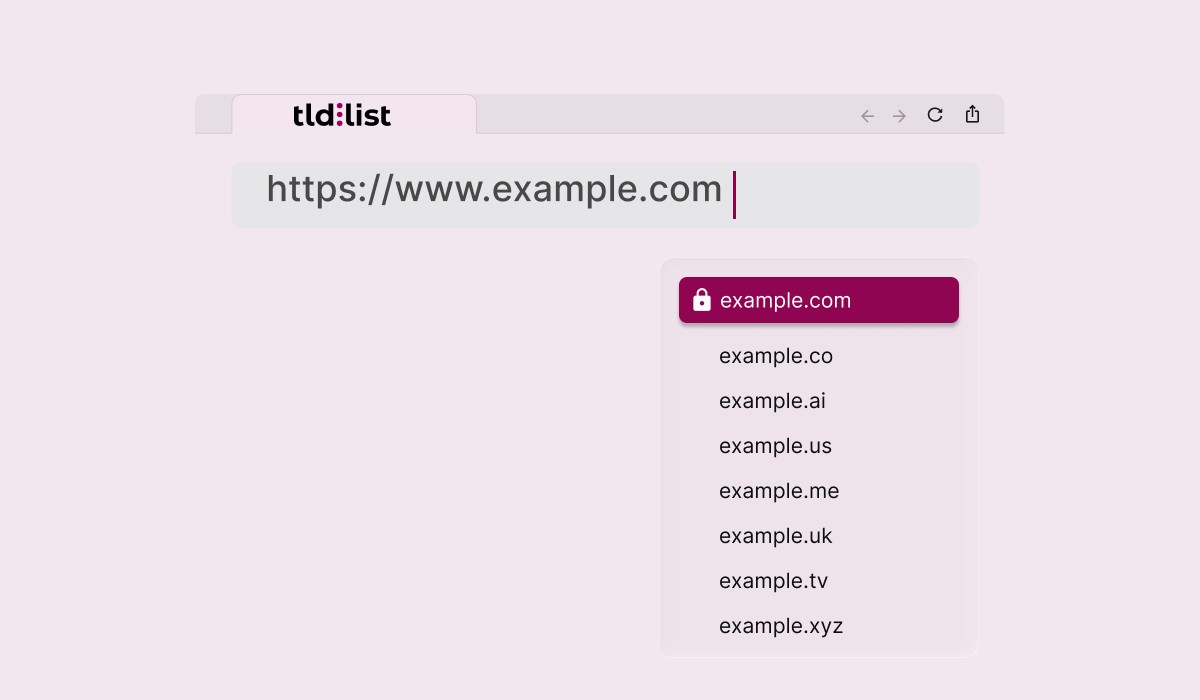
google.com is a domain name. "google" is the name chosen at registration and ".com" is the extension. If you have ever wondered exactly what a domain name is, it is simply the human-readable address of a website that points visitors to the correct server so their browser knows where to load a page from. Domain names come in many forms, from global extensions like .com and .org, to country-specific ones like .de and .co.uk, to newer options like .io and .ai. This guide shows examples of each domain type so you can see what a domain name looks like before buying a domain of your own.
What does a domain name look like? The basic structure
A domain name has two required parts and one optional part. Understanding this breakdown makes it much easier to compare the different types of domain names you will meet later in this guide.
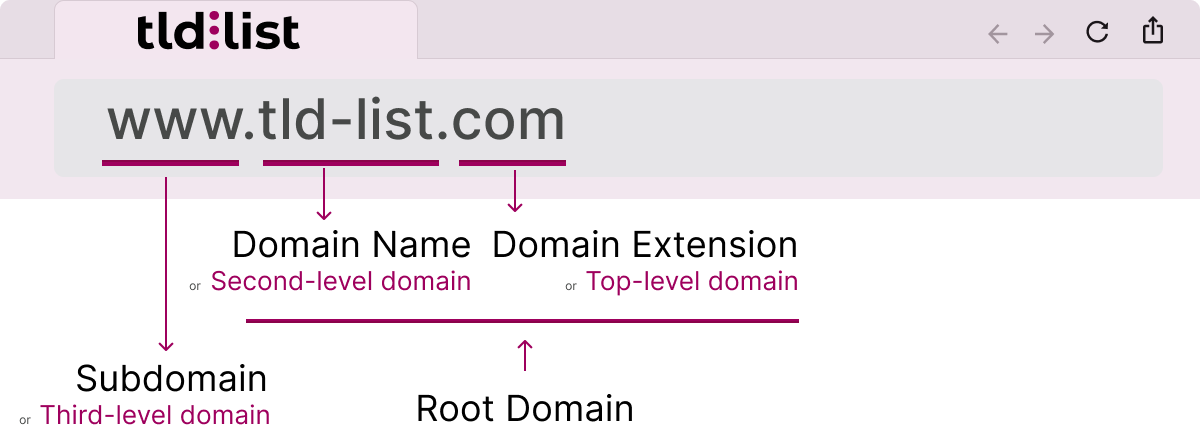
A few examples of how this looks in practice:
- www.tld-list.com, subdomain + second-level domain + TLD
- google.com, second-level domain + TLD only (no subdomain)
- support.amazon.co.uk, subdomain + second-level domain + two-part country code TLD
Most websites use only the second-level domain and TLD. A subdomain is a third-level domain that appears when a site has organized content into distinct sections, such as docs.stripe.com for documentation or api.github.com for a developer API. Each third-level domain is configured in DNS settings rather than registered separately. Behind the scenes, the domain name system translates every one of these names into the IP address of the machine that serves the site, so visitors never have to remember a string of numbers.
Generic domain name examples (.com, .org, .net)
The most widely used domain extensions are the original generic top-level domains (TLDs): .com, .org, and .net. These extensions are open to anyone and carry no geographic restriction.
| Domain | Extension | Typical use | Approx. renewal/year |
|---|---|---|---|
| wikipedia.org | .org | Non-profit encyclopedia | $10.39 Compare .org prices |
| github.com | .com | Developer platform | $10.15 Compare .com prices |
| archive.org | .org | Non-profit digital library | $10.39 Compare .org prices |
| cloudflare.net | .net | Network infrastructure | $11.11 Compare .net prices |
Country-code domain name examples (ccTLDs)
Country-code TLDs (ccTLDs) are two-letter extensions tied to specific countries or territories. These country-code TLDs can be required for certain local markets and can boost local credibility in search results.
| Domain | Extension | Country | Cheapest renewal/year |
|---|---|---|---|
| bbc.co.uk | .co.uk | United Kingdom | $5.30 Compare .co.uk prices |
| lemonde.fr | .fr | France | $7.00 Compare .fr prices |
| spiegel.de | .de | Germany | $3.18 Compare .de prices |
| huggingface.co | .co | Colombia (used globally) | $25.03 Compare .co prices |
 A few things to know about ccTLDs:
- Some ccTLDs require proof of local presence or residency to register.
- Google treats most ccTLDs as geographic signals, which can support local search rankings.
- Some ccTLDs, particularly .co and .io, have been adopted as general-purpose extensions by brands outside their home countries.
Registration policies and prices vary significantly by country. Check renewal pricing before you register a domain name with any country-code TLD.
New gTLD domain name examples (.io, .ai, .app, .shop)
New generic TLDs launched after 2012 and now cover hundreds of extensions tied to industries, activities, and use cases. They let brands communicate something specific through the suffix itself.
| Domain | Extension | Signal | Cheapest renewal/year |
|---|---|---|---|
| linear.app | .app | Software application | $13.99 Compare .app prices |
| cursor.sh | .sh | Developer tool | $27.09 Compare .sh prices |
| perplexity.ai | .ai | AI and machine learning | $79.98 Compare .ai prices |
| shop.store | .store | E-commerce | $28.64 Compare .store prices |
New gTLD renewal pricing is often much higher than the first-year promotional price. A domain that costs $5.00 to register in year one may renew at $60.00 or more. Always check the renewal price before you register a domain name.
Subdomain examples and when they are used
Subdomains allow site owners to organize content under the same root domain. They are free to create once you own the main domain, so no separate registration is needed.
| Subdomain | Full domain example | Use |
|---|---|---|
| blog | blog.company.com | Blog section |
| shop | shop.company.com | Online store |
| docs | docs.stripe.com | Developer documentation |
| support | support.apple.com | Customer support |
| api | api.github.com | API endpoint |
| app | app.supervisible.com | Gated web app |
Subdomains are configured in your domain name system (DNS) settings, usually through the dashboard of your web host or registrar. They share the root domain's ownership and are not registered as separate domains. When you own company.com, you can create as many subdomains as your web host or DNS provider allows at no extra registration cost, and each one still resolves to the same underlying server.
Choosing a domain name? Criteria with examples
The perfect domain name is one that readers can hear once and type correctly. A few criteria to check before buying a domain:
- Short and memorable. airbnb.com is eight characters and easy to say. affordablevacationrentals.com is descriptive but hard to share verbally or remember precisely.
- Easy to spell and say. zoom.us is short and phonetically clean. fiverr.com uses an unusual double-r spelling that took time to establish as a recognizable brand. That works for established companies, but it creates friction for new ones.
- Extension match. Use .com for sites intended for a global audience. If your business serves one country, a ccTLD can reinforce local relevance. For products in specific industries such as developer tools, AI startups, and apps, industry-specific extensions like .io, .ai, and .app have become widely recognized.
- Renewal cost reality. Compare year-two pricing before registering, not just the first-year promotional price. The cheapest first-year option is not always the lowest long-term cost. Remember that the price you pay covers the name only, not the web host or server that stores your site's files, which are billed separately.
Frequently asked questions
google.com is a classic example of a domain name. It has two parts: "google" (the second-level domain chosen at registration) and ".com" (the top-level domain, or extension). Other simple examples include wikipedia.org, github.com, and bbc.co.uk.
example.com (along with example.org and example.net) is a reserved domain maintained by IANA, the Internet Assigned Numbers Authority. It is used in documentation, tutorials, and technical examples where a real domain is needed without pointing to an actual website. It cannot be registered by the public.
A custom domain is a domain name you register and configure to point to a specific website, instead of using a default subdomain provided by a platform (such as yoursite.wordpress.com). Custom domains are registered through a domain registrar and give a site a professional, branded address of a website that visitors will remember.
Yes, significantly. .com domains typically renew at $10.00–$15.00 per year. New gTLDs like .ai and .io can renew at $50.00–$100.00 per year. Country-code domains vary by country, some are under $5.00 and others exceed $30.00. Always check renewal pricing before registering, not just the first-year promotional price.
A domain is just the address, for example example.com. A URL is the full path to a specific page, including the protocol and any subpath, for example https://example.com/about. The domain is one component of the URL, and behind it the domain name system maps that address to the IP address of the server hosting the page.
Find the perfect domain name, compare prices across 100+ registrars before you register.
About the Author:

TLD-list
Editor team
Small crew of builders who believe a great idea should not be held back by a bad domain deal. We know this space inside out, from obscure new extensions to the registrar tricks that quietly inflate your renewal. We put that knowledge to work so you can spend less time worrying about domains and more time building the thing that matters.
Related Posts
How much does a domain name cost?
A standard domain name costs $10–$20/year, but the real number depends on your extension, registrar, and renewal price. This guide breaks down every factor, including premium domains, free options, and how to compare total costs accurately.
Read Full ArticleThe different types of domain names
A complete guide to the different types of domain: how domain names are structured (TLD, SLD, subdomain), every extension from .com and country-code TLDs to new gTLDs, and how to choose the right domain for your brand, budget and search visibility.
Read Full ArticleParts of a Domain Name
Learn the different parts of a domain name, including subdomains, second-level domains (SLDs), and top-level domains (TLDs). Understand how each component works, how they fit into a URL, and how to choose the right domain structure for branding, DNS, and SEO.
Read Full ArticleWhat is a fully qualified domain name?
Learn how FQDNs work, their structure, common uses, and how to find yours.
Read Full Article