- cctld domains
- GccTLDs
- .io Domain Name
The .io domain name: what this domain extension means and who should register it
The .io domain name has a story most of its users have never heard, and it is a strange one. It starts on a chain of islands in the Indian Ocean, winds through the Cold War, passes through a $70 million acquisition, and ends up on the homepages of some of the most recognized tech products.

TLD-list
Editor team
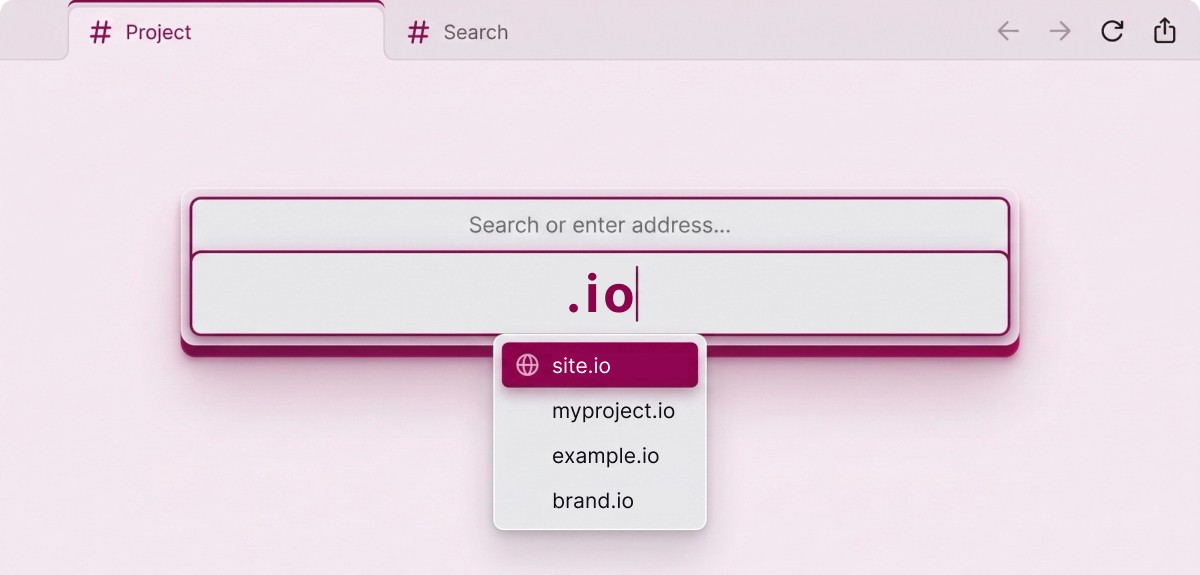
Understanding the full picture; where .io came from, who controls it today, how Google treats it for SEO, and what the ongoing sovereignty dispute over the British Indian Ocean Territory means for anyone who registers a domain there; helps you make a genuinely informed decision about whether it belongs in your brand's future.
This guide covers all of it.
What Does .io Mean? The Top-Level Domain Behind a Tech World Phenomenon
How the British Indian Ocean Territory Became an Internet Brand
.io is a country code top-level domain; a ccTLD; assigned to the British Indian Ocean Territory, a remote archipelago in the Indian Ocean more commonly known as the Chagos Archipelago. BIOT has no permanent civilian population; the islands were forcibly depopulated by the British government in the 1960s and 70s to clear the way for a joint UK-US military base on Diego Garcia.
When the Internet Assigned Numbers Authority delegated the .io code in September 1997, it went to British entrepreneur Paul Kane, who operated it under the trade name Internet Computer Bureau (ICB). The territory had no civilians to serve and no government infrastructure to restrict who could register a domain; an unusual combination of openness that, combined with a two-letter extension that happened to mean something specific in computer science, set the stage for what followed.
The first domain registered under .io was levi.io, secured by Levi Strauss & Co. in 1998. At that point, it was a curiosity. By 2017, when Paul Kane sold the Internet Computer Bureau to Afilias for $70.17 million, .io was already a phenomenon. The registry later passed through Donuts and then to Identity Digital, which manages it today through its ICB subsidiary.
I/O, Input/Output, and Why Tech Adopted This Domain Name
In computer science, I/O stands for input/output; the fundamental operation by which systems receive and send data. Every DNS query, API call, and terminal command is built on this principle. When developers and founders encountered a two-letter website ending that encoded a core concept of their field, the appeal was immediate.
The .io domain name became popular among tech startups not only because the .com domain names they wanted were already taken (though that helped), but because .io signaled something specific: this product is built for technical people, by technical people. The extension functioned as identity before the product even loaded.
That signal is now established enough to function as a brand cue. When you see a .io address, you do not need a tagline to understand the context. For SaaS products, developer tools, and APIs especially, that shorthand has real value; and it is one reason .io became a popular TLD rather than just a trendy one.
The geographic breakdown of .io domain registrations
As expected, .io has evolved into a truly global domain, with registrations overwhelmingly concentrated abroad:
| Share | |
|---|---|
| Registered outside the British Indian Ocean Territory | 99.99% |
| Registered in the British Indian Ocean Territory | 0.01% |

.io registration, transfer, and renewal prices
Visit this page to compare .io domain prices starting from $14.98 for registration.
Who Uses .io Domains?

Tech Startups, SaaS and Developer Tools
Notable tech companies using .io include Sentry (sentry.io), the error-tracking platform used by over four million developers; GitHub, which uses github.io to host user and project pages; Etherscan (etherscan.io), the primary Ethereum block explorer and Itch.io, one of the internet’s largest indie game marketplaces. It’s not just established tech companies, either. Around 292 of Y Combinator’s ~5,000 backed startups also use a .io domain, underscoring the extension’s popularity across the tech industry.

Browser Games: The Unexpected Side of the .io TLD
One of the most unexpected uses of the extension has nothing to do with enterprise software. In 2015, Agar.io; a simple multiplayer browser game; went viral and introduced millions of casual players to a .io address. A year later, Slither.io replicated that success. Together they launched an entire genre: the .io game.
Open Source, APIs and Portfolio Projects
Beyond products and games, the .io top-level domain is widely used for open source project documentation sites, technical portfolios, API documentation, and developer landing pages. GitHub Pages, which allows developers to host static sites directly from their repositories, uses the github.io domain; meaning a significant portion of the developer community's personal projects already live on .io by default.
For individual developers, a .io domain name often carries more credibility than a .com in technical contexts, precisely because it reads as intentional. That dynamic makes .io an accessible entry point for early-stage projects and side experiments, not just funded companies.
Popular domains using .io
Let’s turn to the Majestic Million, which ranks the world’s top one million websites by authority, to see the 10 highest-ranking .io domains:
| Rank | Domain | Domain |
|---|---|---|
| 44 | github.io | Code hosting & version control platform |
| 226 | wpguardian.io | WordPress security and monitoring platform |
| 270 | readthedocs.io | Documentation hosting platform |
| 699 | trustindex.io | Review management tool |
| 745 | itch.io | Indie game marketplace |
| 758 | webflow.io | No-code website builder and hosting platform |
| 855 | redis.io | In-memory database and cache |
| 1,018 | complianz.io | Cookie consent and privacy compliance suite for WordPress and Shopify |
| 1,036 | gitbook.io | Collaborative documentation platform |
| 1,097 | codepen.io | Social development environment for front-end designers and developers |
| 1,183 | gohugo.io | Static site generator |
The SEO concern: How Google Treats .io; Generic TLD, Not Country-Targeted
This is one of the most common questions about the .io domain, and the answer matters practically. Despite being a ccTLD, Google treats .io as a generic domain rather than a country-targeted one. In Google's documentation, .io sits in a category sometimes called a generic ccTLD (gccTLD): a country code that users and website owners see as treated as a generic extension rather than a geographic signal.
What that means in practice: registering a .io domain does not signal to Google that your content is intended for users in the British Indian Ocean Territory. Your site will not be geo-targeted to a territory with no civilian population. It competes globally in search results on the same basis as a generic top-level domain like .com or .net; and this is materially different from extensions like .fr or .de, which carry geographic signals that can limit or help rankings depending on your target market.
The extension itself does not improve or hurt your SEO performance directly. Rankings come down to content quality, relevance, backlink authority, technical health, and user experience. What the .io extension can support indirectly is click-through rate; in contexts where your audience recognizes the signal, a .io domain name builds trust quickly, which has downstream effects on engagement and SEO performance over time.
What it does not do is substitute for any of the fundamentals. A .io address on a slow, thin-content site ranks just as poorly as a .com in the same condition.
.io vs Other TLDs: Comparing This Popular Domain Extension
| Extension |
Registrations |
Cheapest prices |
SEO geo-targeting |
Audience signal |
|---|---|---|---|---|
| .com |
~161M |
Registration: $3.80 Renewal: $10.15 Transfer: $3.94 |
Global (neutral) |
Universal / all audiences |
| .io |
~1M |
Registration:$14.98 Renewal:$40.47 Transfer:$17.45 |
Global (neutral) |
Tech, SaaS, developer tools |
| .ai |
~848K |
Registration:$79.98 Renewal:$79.98 Transfer:$79.98 |
Global (neutral) |
AI/ML products specifically |
| .co |
~2.5M |
Registration:$4.96 Renewal:$25.03 Transfer:$7.45 |
Global (neutral) |
Companies / startup shorthand |
.io VS .com; Availability, Brand Fit and Cost
.com is the default domain extension for almost everything on the internet. With around 133 million domains registered, .com accounts for roughly 41% of all global registrations. That scale means availability for short, meaningful names is severely constrained. If your preferred name on .com is already taken, you face a choice: pay a secondary-market premium, modify the name, or use a different extension.
.io offers meaningfully better availability. With just over 1 million domains registered at the time of this writing; compared to .com's 133 million; the odds of finding your target name, or a close variant, are considerably better. That gap in availability is one of the main practical reasons the .io domain name became the first choice for tech founders who could not get their preferred .com.
The trade-off is price. A .io registration typically costs between $14.98 and $60 per year depending on the registrar, compared to roughly $10–12 for a standard .com. Over ten years, that difference adds up; but for a funded startup where the name matters, it is rarely the deciding factor.
.com also carries more universal trust with non-technical audiences. If your product is consumer-facing or targets users without a tech background, that muscle memory matters. For B2B SaaS startups and developer tools, it is far less of a concern.
.io vs .ai; Two Tech Domain Extensions, Different Signals
The ai domain; technically the ccTLD for Anguilla; has followed a trajectory remarkably similar to .io: a country code repurposed by the tech ecosystem, this time driven by the AI boom rather than the broader startup wave. With around 848,000 domains registered and prices running $80–100 per year, .ai is both smaller and more expensive.
The key difference is specificity. An .ai domain says: we are an artificial intelligence product. A .io domain says: we are a tech product. For tech and SaaS startups that are not specifically AI-focused; developer infrastructure, B2B tools, fintech; .io is the more neutral and versatile signal. For an AI company, .ai communicates the category more precisely.
Both are treated similarly from a SEO perspective: neither carries a geographic targeting signal that limits global ranking, and both are recognized by Google as de-facto generic TLDs. The choice between them is primarily a branding and positioning question.
.io vs .co; The Other Startup Shorthand
.co is another ccTLD that crossed into mainstream startup use; assigned to Colombia but recognized globally. With over 2.5 million domains registered, .co sits between .com and .io in scale. It is a common choice when the preferred name is taken on .com: startup.co carries an implicit meaning as "startup company" that works across languages and audiences.
Where .io signals "tech product," .co signals "company." They appeal to partially overlapping but distinct audiences. A consumer brand or fintech might find .co a more natural fit; a developer tool or API-first product is more at home on .io. If you are comparing the two as domain extensions, the question is mostly about what you want the extension itself to communicate.
What to Know Before You Register a .io Domain
.io's Registration Rules and Eligibility
.io domain registration is open to anyone, worldwide. There are no residency requirements, no local presence requirements, and no industry restrictions; which follows logically from the territory having no civilian population to prioritize.
The only requirements that apply to .io domain names are technical and content-based: labels must be between 3 and 63 alphanumeric characters (hyphens allowed but not at the start or end), and domains cannot be used for pornographic content or anything that violates the statutory laws of any nation. Registrations run for one to ten years.
Third-level domains (e.g. example.co.io) are technically restricted to inhabitants of BIOT; in practice, no one. All meaningful .io domain registration happens at the second level.
.io's Domain Registration Cost: Why It's Priced at a Premium
.io domains cost more than most domain extensions, and the reason is structural. The registry sets its wholesale price at a significant premium, which registrars pass on to consumers. Where .com benefits from global scale and decades of low-cost infrastructure, .io operates through a smaller registry with higher per-unit pricing.
As of now, io domain registration starts at $14.98 through Spaceship, with pricing varying across 53 registrars. You can compare current .io pricing across all options at tld-list.com/tld/io.
Renewal rates are where the real variance appears; some registrars offer low first-year prices that jump significantly at renewal. Factor the full renewal cost into your decision, not just the registration price. Domain privacy (if not included) adds to the total cost at some registrars.
.io's WHOIS, Domain Privacy and What's Protected
Like most domain extensions, .io domains are subject to WHOIS lookup; public records that display registrant information including name, email, and sometimes address. WHOIS privacy (also called domain privacy) is available through most registrars and replaces your personal information in the WHOIS database with the registrar's contact details.
Not all registrars include domain privacy at no additional cost; some charge separately for it. When comparing registrars for your .io domain, factor the total cost including privacy protection. On some registrars, free whois privacy is included by default; on others it adds $5–15 per year.
Should Changes in Chagos Sovereignty Influence Your Decision?
This is the question that has generated the most uncertainty around .io domains since 2024, and it deserves a direct answer.
In October 2024, the United Kingdom announced that it would transfer sovereignty over the Chagos Archipelago to Mauritius. A formal agreement was signed on May 22, 2025. The British Indian Ocean Territory; the territory to which .io is assigned to the British Indian Ocean Territory country code; would effectively cease to exist once the treaty enters into force.
Under current IANA rules, when a territory loses its ISO 3166-1 country code, the corresponding ccTLD can be phased out. However, ICANN issued a statement in November 2024 making clear that any transition would take a minimum of five years from the removal of the IO code from ISO 3166-1; and that removal is not automatic or immediate upon the sovereignty transfer.
Historical precedent matters here: the .su domain, assigned to the Soviet Union, still exists and carries over 100,000 active registrations despite the USSR having dissolved in 1991. Exceptions and extended timelines are not unusual.
The practical reality for anyone registering a .io domain today: your domain name is stable in the near to medium term. A five-year minimum phase-out window; if triggered at all; gives ample time to migrate if needed. For most startup teams, this is background information worth monitoring, not a reason to avoid .io entirely. If you are building a brand where the extension is deeply embedded in your identity, it is worth keeping an eye on ICANN and Identity Digital communications going forward.
Is .io the Right Domain Extension for Your Brand?
.io is the right choice when at least two of these are true: your target audience is technical; your preferred name is not available on .com at a reasonable price; and you are building a product where the tech association of the extension reinforces rather than confuses your brand. For tech startup teams and developer-facing products, that combination is common.
It is probably not the right domain extension when your audience is primarily non-technical consumers; when you need to communicate trust to audiences outside the tech ecosystem; or when the annual cost difference between .io and a .com alternative is a material constraint on an early-stage budget.
For SaaS and developer-facing products specifically, .io remains one of the most credible and recognized domain extensions available. A well-chosen .io domain name is short and memorable, immediately signals context to the right audience, and opens access to names that would cost far more; or be entirely unavailable; on .com.
The Chagos sovereignty situation adds a background consideration worth tracking, but not one that should drive a near-term decision away from .io for most use cases. The internet country code has shown, repeatedly, that political changes do not automatically erase internet infrastructure.
About the Author:

TLD-list
Editor team
Small crew of builders who believe a great idea should not be held back by a bad domain deal. We know this space inside out, from obscure new extensions to the registrar tricks that quietly inflate your renewal. We put that knowledge to work so you can spend less time worrying about domains and more time building the thing that matters.
Related Posts
What is a domain name? A beginner’s guide to domain management
This guide explains what domain names are, how they’re structured, the main types of extensions, and what registration, renewal, and transfer costs mean, including how each affects choosing and managing a domain.
Read Full ArticleAll about the .me domain Name
Meet .me, Montenegro's country code domain that the whole world uses for personal brands. Because "me" is a real word, names like about.me and hire.me read like sentences. Learn where it came from, why Google ranks it globally like a .com, and how it compares to .com, .co, and .io.
Read Full ArticleAll about the .gg domain Name
The .gg domain means two things at once: Guernsey's country code, and "good game" to every player alive. That double meaning made a tiny island's extension a global favorite for gaming brands like discord.gg. Learn who can register one, why it costs more, and how Google treats it for SEO.
Read Full ArticleThe domain name system explained
Learn how DNS translates domain names into IP addresses, how DNS lookups work, key record types, and what every domain owner should know.
Read Full Article