The .app domain name: What this top-level domain means and who should register it
This guide covers what the .app domain is, why the HTTPS requirement matters in practice, who actually uses it, how search engines treat it, and how it compares to the other extensions you might be weighing for your project.

TLD-list
Editor team
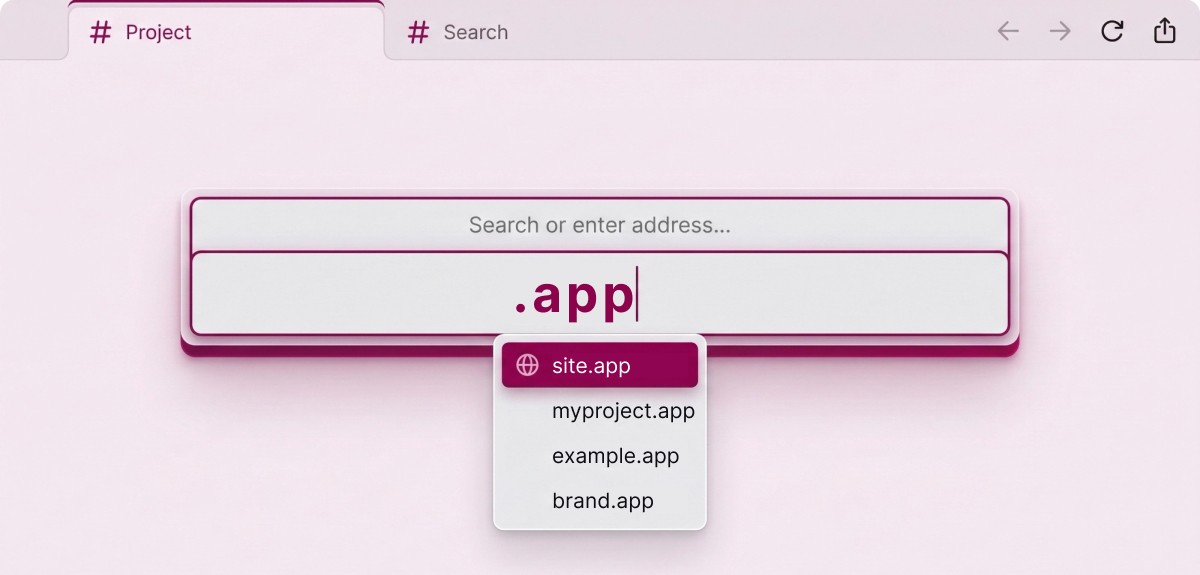
Most domain extensions ask you to trust that a site is secure. The .app domain name does not ask. It requires it. Every website on a .app domain has to load over an encrypted HTTPS connection, with no exceptions and no opt-out, because the whole top-level domain is built on a security rule enforced inside the browser itself.
That single design choice is what makes .app different from almost every other domain extension you can register. It is backed by Google, and it was designed from the start as a home for apps, app developers, and businesses building an online presence around them.
What does .app mean? The top-level domain backed by Google
The .app domain is a generic top-level domain, or gTLD. A top-level domain (TLD) is the part of a web address that comes after the final dot, like .com, .org, or in this case, .app. Generic top-level domains, also called generic TLDs, are the open, themed extensions introduced to expand the namespace beyond the original handful, and .app is one of the most recognizable of that generation. Behind the scenes, a .app address resolves through the domain name system (DNS) like any other domain.
Unlike a country-code extension tied to a specific territory, .app carries a clear meaning on its own. The word app is universal shorthand for an application, whether that is a mobile application, a web app, or a desktop tool. For developers and businesses launching software, the extension states the purpose of the site before a visitor reads a word.
From a record $25 million auction to general availability
The .app extension exists because of a bidding war. When ICANN opened applications for new generic top-level domains, .app was one of the most contested. Google, through its Charleston Road Registry, won it at an ICANN auction in 2015 with a bid of $25 million. That made it the most expensive new top-level domain ever sold through the process, ahead of bids from Amazon and a dozen other applicants.
Google did not open registration right away. After the standard sunrise and early access periods for trademark holders and early adopters, the .app extension reached general availability in early May 2018. And it has been an active, openly available extension ever since, operated by Google Registry.
A generic top-level domain that can be registered by anyone
There are no eligibility rules for a .app domain. You do not need to be a software company, own an app in an app store, or prove any credential. The extension can be registered by anyone, from an individual developer shipping a side project to an established brand protecting its name.
What you do take on is the security requirement that comes with every .app domain, which is the part most new owners do not expect.
Why every .app domain requires HTTPS, and what that means for you
HSTS, the preload list, and a secure namespace
When Google launched .app, it added the entire extension to something called the HSTS preload list. HSTS stands for HTTP Strict Transport Security, a setting that tells web browsers to only ever connect to a site over a secure HTTPS connection. The preload list is a register of domains, built into Chrome, Firefox, Safari, and other major browsers, that should never be loaded over an unencrypted connection.
Most websites add themselves to that list one domain at a time. With .app, Google added the top-level domain itself. That means every .app domain sits on the HSTS preload list automatically, from the moment it is registered, with no action required by the owner. The result is a secure namespace where encryption is not optional. It is the default, applied before your site even loads. No other widely used namespace enforces it this completely.
What the HTTPS requirement means in practice
In practical terms, a .app website will not open in a browser unless it has a valid SSL certificate installed. An SSL certificate is the file that enables the encrypted HTTPS connection and proves the site is what it claims to be. On most extensions, serving your site over plain HTTP still works, even if it is not recommended. On a .app domain, it simply does not. A visitor who tries to reach an unsecured .app site sees a browser security warning instead of your content.
Put plainly, .app domains require HTTPS, with no way to turn it off. For most owners this is a one-time setup step, not an ongoing burden. Many registrars and hosting providers include a free SSL certificate, often through Let's Encrypt, and renew it automatically. If you are launching anything on .app, confirm that your host issues and renews SSL for you. Once that is in place, the rule that HTTPS is required works quietly in the background and gives every visitor HTTPS by default.
Use cases for .app domain name

App developers and software developers
As you would expect, the extension is very popular in the tech industry. Software developers use .app domains for mobile apps, web apps, and developer tools, with 71 Y Combinator startups adopting the extension. Its mandatory HTTPS is also a strong trust signal, reassuring potential users that security is built in from the first visit.

App landing pages, businesses, and brands
Beyond individual developers, businesses use .app domains to give a product its own brand and a dedicated destination, often linking directly from an app store listing. Established brands also register matching .app domains to protect their name and secure a ready home for future apps before someone else claims it.
6 domains among the top 1K most visited sites in the world use .app, including all public static sites hosted on Firebase, Netlify, or Vercel. Here's a list of the first domains using .app amongst the top 1M most visited sites in the world:
| Rank | Domain | Domain |
|---|---|---|
| 167 | bsky.app | Decentralized social media platform |
| 363 | vercel.app | Cloud platform for building and deploying web applications and sites. |
| 413 | netlify.app | Cloud computing platform for web development and hosting |
| 1,244 | web.app | Firebase hosting service for web applications |
| 1,333 | lovable.app | AI-powered full-stack web application builder that uses natural language prompts. |
| 3,106 | gamma.app | AI-powered platform for creating presentations, documents, and websites |
| 4,479 | cash.app | Mobile payment service for sending, receiving, and investing money |
| 6,598 | lmgtfy.app | Tool to create search links for others to use search engines themselves |
| 7,083 | s-gift.app | Online and mobile gift-giving platform |
| 9,472 | run.app | GPS running tracker and activity logger |
| 9,901 | framer.app | Visual design and prototyping tool for creating interactive websites without code |
Does the .app domain extension affect SEO and search engines?
As a gTLD, .app extensions, are one of the best domain extensions for SEO for sites with a global presence. Organic SEO rankings in search results are determined by content, relevance, links, and technical quality. However, some still prefer an original gTLD such as .com over newer extensions like .app, arguing that stronger familiarity and brand recognition can lead to higher click-through rates, which has an effect on relevancy signals. A relevant domain name and the built-in SSL connection can still provide indirect benefits by improving user trust and encouraging clicks.
How .app compares to other domain extensions for your app
If you are choosing a domain for an app or a software product, .app is rarely the only option on the table. Here is how it compares to the extensions it most often goes up against.
| Extension |
Registrations |
Built-in HTTPS |
Typical audience signal |
|---|---|---|---|
| .app |
~802K |
Required (HSTS) |
The application itself |
| .com |
~161M |
Not enforced |
Universal / all audiences |
| .dev |
~468K |
Required (HSTS) |
Developers and dev tools |
| .io |
~1.0M |
Not enforced |
Tech / startups / SaaS |
| .ai |
~848K |
Not enforced |
AI / ML products |

The .app domain vs the .com domain
The .com domain remains the default for most domains, but its popularity makes short, memorable names difficult to secure. A .app domain offers better name availability and built-in security, while .com may still inspire more familiarity among a broad consumer audience.

The .app domain vs the .dev domain
Like .app, .dev is a Google Registry extension with HSTS enabled. The difference is audience: .dev is aimed at developers, developer tools, and documentation, while .app is intended for the application itself. Many teams own both, using .dev for technical resources and .app for the public product.

The .app domain vs .io and .ai
The .io and .ai domains have become synonymous with the tech startup ecosystem, while .app clearly signals an application to both technical and non-technical users. Unlike .io and .ai, .app includes built-in security, making it an attractive choice for consumer-facing apps.
What to know before you register a .app domain
Registration rules and who can register
The .app extension has no special eligibility rules. It can be registered by anyone, with standard domain name requirements: 3 to 63 characters, made up of letters, numbers, and hyphens, with no hyphen at the start or end. Registrations run in terms of one to ten years, and the only condition unique to the extension is the one already covered, that the site must be served over HTTPS.
Some short, high-demand .app names are sold as premium domains, which carry a higher registration and sometimes renewal price set by the registry. If a name shows a premium price, that is why.
Pricing, renewal, and domain expiration
Pricing for a .app domain varies by registrar, and the first-year price is not the whole story. The renewal price is what you pay every year after, and it is often higher than an introductory rate. Always check the renewal cost before you register, not just the first-year deal.
As a reference point, .app registration currently starts around $4.98 at Spaceship, with pricing available across 49 registrars. You can compare current registration, renewal, and transfer prices for every registrar at tld-list.com/tld/app.
One more cost-related point worth planning for is domain expiration. If a .app domain lapses, it goes through a renewal grace period and then a redemption window before it is released. Set auto-renew or a reminder so a domain you care about does not expire by accident.
WHOIS and WHOIS privacy
Like other domains, .app registrations appear in WHOIS, the public lookup that can show registrant contact details. WHOIS privacy replaces your personal information with the registrar's details and is offered by most registrars, sometimes free and sometimes for a small annual fee. If keeping your details private matters, confirm whether WHOIS privacy is included before you choose where to buy.
Is .app the right domain for your project?
The .app domain is the right choice when your project is an application and you want that to be clear at a glance, when a guaranteed HTTPS connection fits the trust you need to convey, and when you want a clear, available name without paying a premium for a crowded extension. For app developers, software teams, and businesses launching a product, that combination lines up well.
It is a weaker fit when your audience is broad and non-technical and expects a .com, or when you are not set up to maintain an SSL certificate, though for most modern hosting that is handled automatically.
For apps specifically, .app is one of the few extensions where the name and the security model work together. It tells people what the site is, and it guarantees how the site is served. If that matches your project, compare current .app pricing across 49 registrars at tld-list.com/tld/app before you register.
About the Author:

TLD-list
Editor team
Small crew of builders who believe a great idea should not be held back by a bad domain deal. We know this space inside out, from obscure new extensions to the registrar tricks that quietly inflate your renewal. We put that knowledge to work so you can spend less time worrying about domains and more time building the thing that matters.
Related Posts
What is a domain name? A beginner’s guide to domain management
This guide explains what domain names are, how they’re structured, the main types of extensions, and what registration, renewal, and transfer costs mean, including how each affects choosing and managing a domain.
Read Full ArticleAll about the .me domain Name
Meet .me, Montenegro's country code domain that the whole world uses for personal brands. Because "me" is a real word, names like about.me and hire.me read like sentences. Learn where it came from, why Google ranks it globally like a .com, and how it compares to .com, .co, and .io.
Read Full ArticleAll about the .gg domain Name
The .gg domain means two things at once: Guernsey's country code, and "good game" to every player alive. That double meaning made a tiny island's extension a global favorite for gaming brands like discord.gg. Learn who can register one, why it costs more, and how Google treats it for SEO.
Read Full ArticleThe domain name system explained
Learn how DNS translates domain names into IP addresses, how DNS lookups work, key record types, and what every domain owner should know.
Read Full Article