- ccTLD Domains
- GccTLDs
- .me Domain Name
The .me domain: Montenegro’s personal-brand domain name, explained
The .me domain is one of the few country domains that almost nobody uses for its actual country.

TLD-list
Editor team
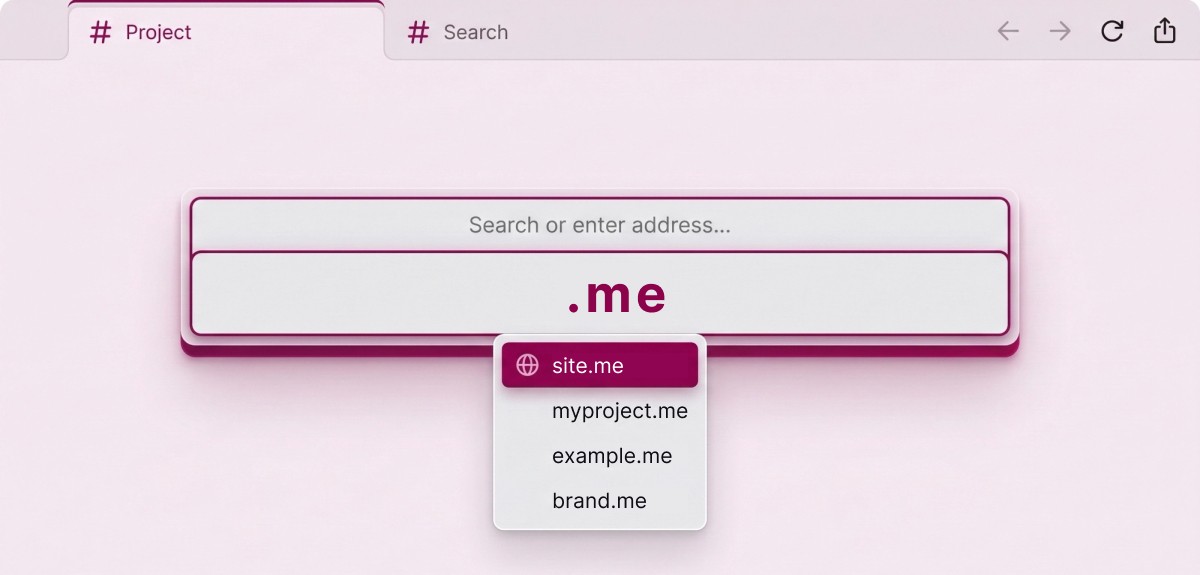
It belongs to Montenegro, but you will find it on personal sites, portfolios, and personal projects all over the world, usually because the domain name reads like a sentence. about.me, hire.me, and fb.me all work because "me" is a real English word, not just a string of letters after the dot.
This guide covers what a .me domain actually is, where it came from, who it is for, how it compares to alternatives like .com, .co, and .io, and what to check before you register one. We will keep the pricing light.
 Register a .me from $1.97
Visit our price comparison page to find the cheapest .me domain registration, transfer, and renewal prices. Where you can also use the search box to check if a domain is available.
What is a .me domain?
A .me domain name is a web address that ends in .me, for example yourname.me. Technically, .me is the country code top-level domain (ccTLD) assigned to Montenegro, the small Balkan country on the Adriatic coast. In practice, it works as a general-purpose domain extension that anyone, anywhere, can register.
That split personality is the whole story of this domain. Most country domains, like .de for Germany or .fr for France, signal "this site is for that country." The .me domain does the opposite. Because "me" is a common word rather than an obvious country marker, people read yourname.me as a statement about a person, not a location. That is why it has grown into one of the more recognizable choices for personal websites and personal use rather than a local tTLD for everyday businesses.
Where the .me domain comes from
From Montenegro's independence to a global extension
The .me extension exists because Montenegro became a country. When Montenegro declared independence in June 2006 after splitting from Serbia, it became eligible for its own country code. ICANN delegated the domain to the new state in September 2007, and the registry opened it to the public in July 2008 after a sunrise period for trademark holders. Fittingly, "domen" is the local Montenegrin word for "domain."
What happened next is the part the operator still likes to mention: .me was one of the fastest-adopted new domain extensions of its era. The reason was not the country itself. It was that .me launched as an open ccTLD with no local-presence requirement, right as people were starting to think about owning their own corner of the web.
Who runs the .me registry
Day to day, the domain is operated by a registry called doMEn, a Montenegro-based venture backed by partners including Afilias (now part of Identity Digital) and GoDaddy. You do not deal with it directly, though. Like most domains, you register a .me name through a retail registrar, and the operator sits behind the scenes managing the central database and DNS for the extension. If you have ever bought a .com, the experience is identical.
2026 geographic breakdown of .me domain registrations
Even though .me still carries strong local recognition in Montenegro, where over 40% of registered domains use the extension, the overall numbers show it has become a global phenomenon:
| Geography | .me Domains | Share |
|---|---|---|
| Registered outside Montenegro | 1,031,782 | 99.63% |
| Registered outside Montenegro | 3,874 | 0.37% |
Why people choose .me: personal brands and domain hacks
A domain name that points at a person
The strongest argument for .me is that it turns a domain name into a personal statement. As a domain name, yourname.me is short, reads naturally, and signals "this is my space" in a way that yourname.com rarely does. That makes the domain name a popular pick for online portfolios, resume sites, personal blogs, and the kind of personalized web presence that freelancers and creators want when their name is the brand. about.me built an entire product on this idea, a one-page personal profile on a .me domain for millions of people. For an individual building a personal brand, the extension does some of the positioning work for you before anyone reads a word, turning a unique and memorable name into an instant online identity.
Domain hacks and action-oriented names
The other reason .me shows up everywhere is the domain hack of using the extension as part of a word or phrase instead of bolting it on. Because "me" is a word, the possibilities are unusually creative, like hire.me, follow.me, or call.me.
Big companies use this for short, action-oriented links. PayPal uses paypal.me for payment-request URLs, and Facebook, Telegram, or Twitter have used this domain ending for their link shorteners. These work as campaign or call-to-action web addresses alongside a company's main domain, not as a replacement for it. There is even a cross-language bonus: in Mandarin, adding "me" can turn a word into a question, which is how the Chinese food-delivery giant ele.me ("Are you hungry?") got its name.
How big is .me, really?
By the numbers, .me is a mid-sized extension that punches above its weight in mindshare. Our own registration data puts the active .me zone at roughly 1.04 million registered domains, about 0.38% of all domains we track. That places it just behind .io and .biz and essentially tied with .dk, which is a useful reality check: the .me domain is well known, but it is not enormous.
The genuinely interesting story here is geographic, and it is exactly the kind of thing our registration database can show but public sources cannot: what share of .me domains sit outside Montenegro. If, as we suspect, the overwhelming majority are registered abroad, that is the single most persuasive data point in the whole article, because it proves the domain long ago stopped being a local extension.
Popular domains using .me
The most visited .me domains in the Majestic Million, ranked by global authority:
| Rank | Domain | Domain |
|---|---|---|
| 20 | wa.me | WhatsApp click-to-chat link generator |
| 38 | t.me | Telegram messenger short links |
| 144 | telegram.me | Cloud-based instant messaging service |
| 155 | line.me | Japanese messaging and social networking app |
| 341 | fb.me | Facebook URL shortener |
| 453 | m.me | Personal profile and social networking link hub |
| 700 | about.me | Personal landing page builder |
| 773 | paypal.me | Personalized payment links |
| 804 | heylink.me | Link-in-bio tool for social media monetization and management |
| 1,135 | onelink.me | AppsFlyer deep linking service |
.me vs .com, .co, and .io
If you are weighing .me against other domain names, the comparison usually comes down to .com, .co, and .io. The .com is still the one most people type by reflex, so if it is available and affordable, it is hard to argue against. The .me domain wins when the site is about a person, because the extension says so on its own. A .co reads as a company or startup play and is the closest thing to a drop-in .com alternative, while .io has become shorthand for tech and developer tools, usually at a noticeably higher domain price. None of these are wrong; they just say different things. For current .me prices and the cheapest registrar, see our .me domain page, where registration currently starts around {me_reg_price} with renewals near {me_renewal_price}.
Is a .me domain good for SEO?
Short answer: yes, with one caveat worth understanding. The common worry is that a country domain like .me will get geo-locked to Montenegro and hurt your rankings everywhere else. It will not. Google treats .me as a generic top-level domain (gTLD), not a country-specific one, precisely because so few sites use it for its home country. That means a .me domain name does not send a "this site is for one country" signal and can rank globally like a .com or .net, giving it genuine global reach. The extension itself is close to neutral for SEO. What actually moves rankings is the usual list: content, backlinks, site speed, and a secure setup with SSL. A .me domain will not hold you back, but it will not do the work for you either.
What to check before you register a .me domain

Availability and premium names
Good short .me domain names go fast, so domain availability is the first thing to check. Single dictionary words and obvious "verb.me" combinations are mostly taken or sold as a premium domain, names the registry prices higher because of their perceived value. If your first choice is already registered, a premium listing or a slightly longer variant is usually the fallback when you buy a domain on this extension.

Renewal, expiration, and the basics
Two practical notes. First, watch the gap between the promotional first-year price and the renewal price. Like most extensions, .me often advertises a low introductory domain registration rate and renews higher, so check the expiration and renewal terms before you commit. Second, the standard housekeeping applies: keep domain privacy on if you do not want your details public, and make sure your registrar supports easy DNS management. Live prices, including renewals, are on our .me domain page.
Frequently asked questions about the .me domain
No. It is the official country code there, but the domain is available to everyone and used all over the world, with no special requirements to qualify.
Yes. There is no local-presence rule, so the extension is open to individuals and businesses anywhere.
It can be, especially for personal brands, freelancers, and short action-oriented campaign links. Many companies register a .me name alongside their main domain rather than instead of it.
It varies by provider and by whether the name is premium. For live, compared prices across providers, our .me domain page is the place to look.
They do different jobs. The .com is the default almost everyone types, while the .me domain name is the stronger pick when the site is built around a person rather than a company.
At a glance:
| Extension |
Associated with |
Price feel |
Best for |
|---|---|---|---|
| .com |
The default |
Low |
Anything, when it’s available |
| .me |
People & personal brands |
Low–moderate |
Personal sites, portfolios, profiles |
| .co |
Companies & startups |
Moderate |
A short .com alternative |
| .io |
Tech & developer tools |
High |
Startups, dev tools, apps |
Table is illustrative; live, compared prices for every extension are on each TLD page on tld-list.com.
About the Author:

TLD-list
Editor team
Small crew of builders who believe a great idea should not be held back by a bad domain deal. We know this space inside out, from obscure new extensions to the registrar tricks that quietly inflate your renewal. We put that knowledge to work so you can spend less time worrying about domains and more time building the thing that matters.
Related Posts
What is a domain name? A beginner’s guide to domain management
This guide explains what domain names are, how they’re structured, the main types of extensions, and what registration, renewal, and transfer costs mean, including how each affects choosing and managing a domain.
Read Full ArticleAll about the .gg domain Name
The .gg domain means two things at once: Guernsey's country code, and "good game" to every player alive. That double meaning made a tiny island's extension a global favorite for gaming brands like discord.gg. Learn who can register one, why it costs more, and how Google treats it for SEO.
Read Full ArticleThe domain name system explained
Learn how DNS translates domain names into IP addresses, how DNS lookups work, key record types, and what every domain owner should know.
Read Full ArticleAll about the .io domain Name
The .io domain name has one of the most fascinating stories of any domain extension. What began as the country-code domain for a remote archipelago in the Indian Ocean became the online home of some of the world’s best-known startups, developer tools, and SaaS companies.
Read Full Article