- Internet Domain Name
- Domain Name Search
- How to Choose One
How to choose a domain name: the complete guide to the best domain for your site!
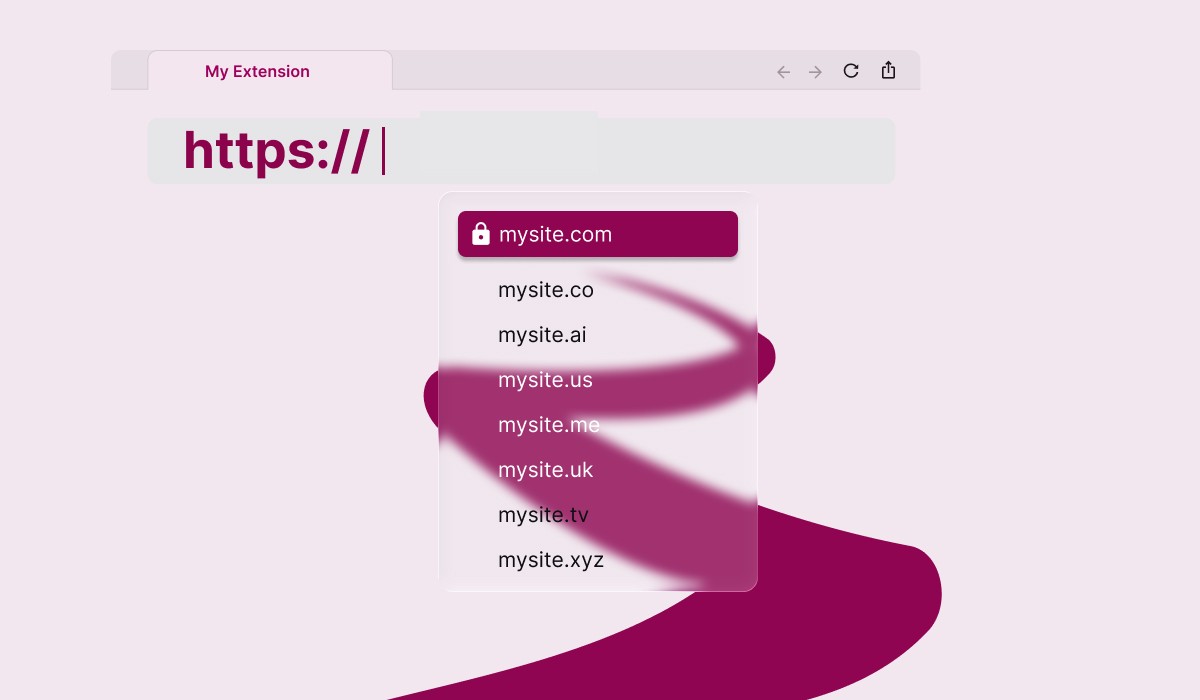
Choosing a domain name comes down to four decisions in sequence: pick a name, select an extension, confirm availability, and compare prices before you register.

TLD-list
Editor team
TLD-list is a neutral price comparison tool (not a registrar), so every recommendation here comes from data rather than from a registrar we sell for.
What makes the best domain name?
The best domain name is short, clear, and easy to pass along by word of mouth. Here are some initial tips, but please keep scrolling if you want to deep dive into picking the right extension for the trust, geography, eligibility, and renewal-cost trade-offs, as well as the six domain naming strategies for how branded, exact-match, and hybrid names behave differently over five years. Treat this section as a filter, not a verdict.
Under 15 characters is the practical target, and most recognized brands sit between six and ten. Memorability drops and typo risk rises with every extra character.
A name that is easy to spell is also easy to type, which matters more than it sounds. Slang, phonetic alternatives, and creative spellings send people to a competitor's site. Say the candidate out loud to someone who has never seen it written down. If they can type it correctly on the first try, it is short enough and clear enough. A name that is easy to remember will outperform a longer, cleverer one every time, while names that force you to spell them letter by letter are harder to remember and never travel by word of mouth.
Plenty of 'domain experts' will tell you to keep numbers and special characters out of your domain name. However, there are nuances to these general rules, and there are always trade-offs; the sweet spot comes from knowing them and navigating them to your advantage.
The cost of a hyphen or a digit is entirely a typing cost. A listener cannot tell whether you mean 5 or five, and punctuation is invisible in speech, so if you expect people to hear your name and type it from memory, or read it off a van or a business card, every extra character works against recognition. That is a real problem for a local service business. If physical word of mouth is not your main channel, the cost mostly evaporates. When search, LLM answers, ads, marketplaces or referral links deliver 90% of your traffic, few users are typing your domain without a search engine auto-completing it. In that scenario a hyphen is a tool: it can free up an exact-match name that is otherwise long gone, and the separator can even make the words scan more clearly than the smashed-together version. Ours does.
A keyword in the name is a weak signal at best. Content quality, authority, and relevance outweigh anything the name itself contributes to search engine optimization.
Putting keywords in your domain still has one real benefit, and it is not SEO: it tells a visitor what the site is about before they click. The trade-off is brandability. A name like cheapdomainnames.com describes a category, it does not represent your brand, and it gives you nothing to own. Use a keyword when it doubles as a brand (Shopify, Booking), not when it forces you into a generic phrase.
Do's and don'ts for choosing a domain name
Run a trademark search before you commit. A name can be free to register and still infringe an existing trademark, which creates legal exposure that availability will never warn you about.
 Do
Do- Keep it under 15 characters
- Use common, standard spellings only
- Test it aloud if word of mouth is a real channel
- Check for existing brand conflicts before committing
- Match the name to the brand, not just the keyword
 Don't
Don't- Add words just to hit a round character count
- Use slang, phonetic, or creative spellings
- Apply typing rules to a name nobody will ever type
- Assume availability means no conflict exists
- Force a keyword in at the expense of brandability
How to choose the right domain extension
Here are four criteria to choose the right extension for your brand:
- Audience and geography. A matching ccTLD strengthens local search signals and local trust for a single-country audience. For a global audience, .com is the safe default.
- Industry signal. .io and .ai read as tech, .org as non-profit, .store as e-commerce. A relevant ending narrows the expectation gap before anyone reads a word.
- Long-term cost. Compare renewals, not intro rates. A $0.99 registration that renews at $40.00 costs more over three years than a steady $12.00 .com.
- Availability. If the name is gone in .com, a close-match ccTLD or a relevant new gTLD beats settling for an ending that fights your brand name. A memorable name on a clear ending is worth more than a perfect domain name stem on an obscure one.
For most proje,cts .com is still the safest choice, especially for non-technical audiences who distrust unfamiliar endings. For developer tools and AI products, .io and .ai add credibility. For a local business, the matching ccTLD usually beats .com on both trust and local relevance. Your choice of TLD is a long-term commitment, so choose the right one on cost and audience fit together rather than on availability alone.
For a deeper look at how the ending affects search visibility, see our guide to best domain extensions for SEO.
Types of web endings
Restricted endings managed by designated organizations: .edu for accredited US educational institutions, .gov for US government bodies, .mil for the US military. These sponsored top-level endings are not open to public registration, and each requires the applicant to meet strict eligibility criteria. The gatekeeping is the point. A .gov or .edu address is instantly recognizable as institutional precisely because you cannot buy one.
The original open set (.com, .net, .org, .info, .biz) is available to anyone anywhere with no geographic or sector restriction. .com alone carries over 303 million registrations, and that scale is exactly why it functions as the default trust signal. Most people expect a business address to end in .com. Its widespread adoption is the asset, not the three letters themselves. gTLDs in this original group also tend to have the most stable pricing of any category.
Two-letter endings assigned to countries and territories: .us for the United States, .de for Germany, .uk for the United Kingdom, .fr for France, .ca for Canada. A country code top-level ending suits businesses serving one market, and it carries a genuine local signal in search results. A .de site targeting German users often outperforms an equivalent .com there. Registration policy varies, so some ccTLDs require a local presence while others are open to anyone. Browse all country-code TLDs before you assume yours is available.
Second-level ccTLDs (ccSLDs)
Some country registries operate a fixed list of official SLDs: .co.uk, .org.uk and .me.uk under .uk, .com.au and .net.au under .au, .co.jp and .or.jp under .jp. That second-level hierarchy is the exception to the read-right-to-left rule, because the registry rather than the registrant defines the label.
These country-code second-level domain slots are a closed set, and ccSLDs are separate registrations from the base ccTLD. Owning tld-list.de gives you no claim on tld-list.co.de. They are registered independently, sometimes with different eligibility rules and always with their own pricing.
| ccTLD |
Second-level examples |
Notes |
|---|---|---|
| .uk | .co.uk, .org.uk, .me.uk, .net.uk |
Widely used; .co.uk is the standard commercial choice |
| .au | .com.au, .net.au, .org.au, .edu.au |
Australian sub-levels require local presence |
| .jp | .co.jp, .ne.jp, .or.jp, .go.jp |
Japan uses a structured hierarchy by sector |
| .de | .co.de, .com.de |
Fewer sub-levels; .de itself is widely used directly |
| .us | None |
.us is a flat namespace; no official sub-levels |
| .ca | None |
Canada uses .ca directly; no official sub-levels |
Check out the rest of country code level domains, looking for the Sub-level table: 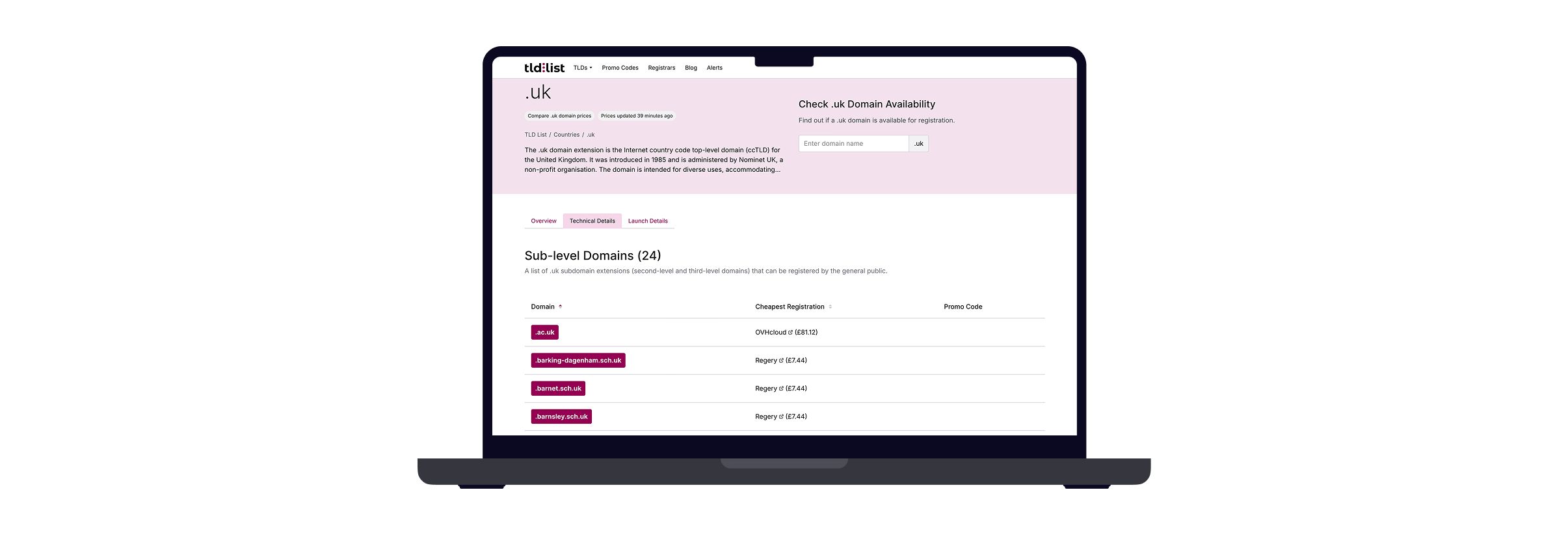 |
||
Availability varies a lot, so check the sub-level table on the relevant TLD page before you plan around one.
 Subdomains that look like extensions
Some registrars or services offer addresses like {yourname}.de.com or {yourname}.us.com. These are subdomains of a premium SLD (de.com, us.com), not a registered ccTLD or sub-level extension. They work as domains, but they carry the limitations and dependencies of a subdomain rather than an independent registration. If you are evaluating one, understand whether you are buying a proper TLD registration or a subdomain of someone else's domain.
Whoever registered the domain above you controls it. Confirm which one you are buying before you build an online identity on it.
More than 1,200 endings arrived through ICANN's new gTLD program from 2013 onward, most of them industry-specific: .io for technology, .ai for machine learning, .app and .dev for software (both enforce HTTPS), .tech, .shop. Pricing is where these bite. Some sell for under $1.00 in year one and renew at $60.00 or more, so a new domain on one of these needs a renewal check before you commit.
.arpa is reserved for technical DNS infrastructure and is not available for public registration. It supports internet protocol functions managed by IANA (Internet Assigned Numbers Authority) and will never be relevant to a commercial project.
6 strategies to choose the domain name for your website
At this point, you have probably already realized that when it comes to domain names, there isn’t a one-size-fits-all formula for the perfect domain.

Branded domains
A branded name is unique to your business and maps to your brand directly, as in paypal.com, stripe.com and shopify.com. These are the most defensible long-term because every bit of equity you build accrues to a word nobody else can use. They are also the hardest to launch, because the word means nothing until you give it meaning.

Exact match domains (EMDs)
Mirrors a search term or category word for word, as in cars.com, cpap.com , and even tld-list.com. Works for high-intent categories and for content or affiliate sites where the name signals the topic.

Keyword-brand hybrid
A category word plus a brand, as in WalmartMoneyCard.com and tescomobile.com. Captures some topical signal while keeping a distinct identity.
 Modified brand or EMD
Including a short action word (get, try, join, use, the) in front of a name already gone, as in getharvest.com, theknot.com and joinhoney.com, allowed these brands to register domains when the .com for their core brand was already registered.

"Extension-integrated" domains
The ending completes the phrase, as in about.me and running.shoes or onlineresume.builders. This is a creative tip for registering a branded domain or an EMD by incorporating the extension into it.

Numeronyms
A number replaces the letters inside a long word, as in i18n (internationalization), a11y (accessibility) and l10n (localization). Only works for audiences who already know the convention.
Whichever route you take, the name has to be unique and memorable enough to survive being repeated once, badly, over a phone call.
How to check availability before domain name registration
Availability is per-ending. A name gone in .com may be free in .io or .store, which is why you should check across multiple domain endings at once instead of stopping at the first red result.
- Domain search tool – search the name across several endings simultaneously so you see every option, not just .com.
- WHOIS lookup – confirm real registration status and check whether an existing registration expires soon. An expiring name may come back.
- Social handle check – confirm X, Instagram and LinkedIn are free before you commit. Consistent naming across channels matters if you plan to build an audience.
Once you know what is available, compare prices. See the domain registration process for what happens after you decide.
How to compare prices before you register a domain
Registration prices are often promotional in year one. Renewal prices can be two to four times higher. A registrar offering .com for $0.99 in year one may charge $19.99 at renewal. Always check the renewal price before committing to any registrar.
This is where most buyers get caught. Registration is a one-time cost. Renewal is what you pay every year for the life of the name, and over five to ten years the gap between registrars adds up to real money.
Search the ending you are considering on tld-list.com and you get registration, renewal and transfer prices side by side across every tracked registrar. Sort by the renewal column, because that is the one that compounds. It takes two minutes, and it is the last step before you register a domain.
Tips for choosing a domain when the perfect domain name is taken
It shouldn’t come as a surprise that after almost half a century of availability, most good names using the .com ending are already registered. But you shouldn’t see this as a dead end: Here are three reasonable paths to take when this happens:
Try the same name with a different extension
Run a multi-TLD search across .io, .co and any relevant country codes, then compare renewals before you pick. A lower renewal can easily offset the weaker trust signal of a less familiar ending, especially for a product whose audience recognizes it anyway.
Add a clarifying modifier
A verb prefix (get, use, try) or a category suffix (app, hq, team) is the cleanest way to reach an available variant. It keeps the core word intact and stays pronounceable.
Use a domain name generator
A domain name generator takes a seed word and returns available variations you would not have thought of. The value is not the suggestions themselves; it is breaking your attachment to the one name you cannot have. Pick a variation that stays short and brandable, then check what it renews for. The generator narrows your options, TLD-list tells you the real cost.
One rule across all three paths: do not force the original name with punctuation or number swaps. Those workarounds read as low-quality to users and hand you a name that is harder to say than the alternative you rejected.
FAQs about choosing a domain name
Google treats all generic top-level domains equally as a ranking input, so a well-optimized .io can outrank a neglected .com. Search terms baked into the name are a weak secondary signal, far outweighed by content quality, authority, and relevance in search engine results pages. Where the ending does matter is trust and click-through rate, which feeds back into performance over time. A ccTLD is the exception worth knowing, because it acts as a positive local signal in its target country.
Defensive registration (buying .com plus .net and .co versions of your name) protects against typosquatting and opportunistic competitors. It does not improve rankings. Whether it is worth the money depends entirely on the renewal prices across all of them, because an extra $30.00 to $60.00 a year per name compounds fast. Compare renewals on TLD-list before you buy the spares.
hopefully under 15 characters, and ideally six to ten. Every extra character is another chance for someone to misspell or misremember it. If the short version of your preferred name is taken, a different ending usually beats padding the name with extra words.
Technically yes. Practically it resets the search equity built on the old domain, requires 301 redirects, and breaks external links and direct type-in traffic. Rebrands happen, but they cost time and traffic. The first decision is the one that counts most, so choose a domain name you can live with for a decade.
Registration is what you pay to reserve the name for the first year, usually at a promotional rate. Renewal is what you pay every year after that to keep it. Registrars routinely advertise first-year rates as low as $0.99 that say nothing about the ongoing cost. Renewal is the number that determines total cost of ownership, so check the renewal column for any ending on TLD-list before you commit to a registrar.
About the Author:
TLD-list
Editor team
Small crew of builders who believe a great idea should not be held back by a bad domain deal. We know this space inside out, from obscure new extensions to the registrar tricks that quietly inflate your renewal. We put that knowledge to work so you can spend less time worrying about domains and more time building the thing that matters.
Related Posts
How to get a free domain name
Not all free domain offers are created equal. This guide explains how to get a free domain through hosting, website builders, and other methods, what you’ll pay after the first year, and how to compare renewal costs before committing.
Read Full ArticleList of country code top-level domains (ccTLD) with every single country domain available
Interactive list to find the country code domain you are looking for.
Read Full ArticleWhat is a parked domain?
A parked domain is a registered domain that isn’t connected to a live website, instead displaying a placeholder, ads, or a for-sale page. Learn how domain parking works, why owners park domains, common use cases, monetization options, costs, and how to unpark a domain when you’re ready.
Read Full Article150+ List of unique domain extensions
Explore 150+ unique domain extensions beyond .com. Browse creative TLDs by brand type and use case.
Read Full Article